


Short answer: A stress concentration is a local spike in stress at a notch, hole, thread or sharp corner — expressed by the theoretical stress-concentration factor Kt. Because fatigue cracks start where stress peaks, rounding transitions and avoiding sharp notches is the main way to make a part survive cyclic load.
At a Glance
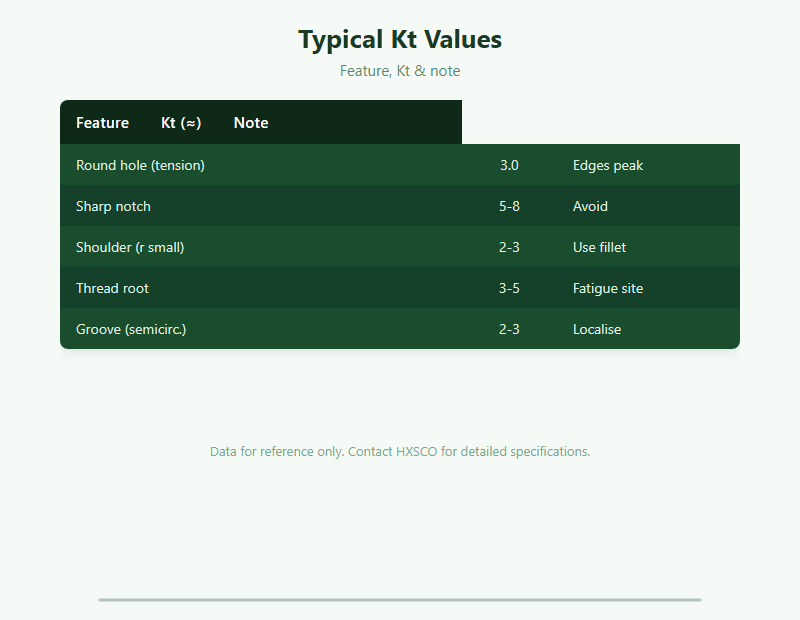
What Kt Means
Kt is the ratio of peak local stress to the nominal far-field stress at a geometric discontinuity. A small hole triples local stress; a sharp notch can raise it five- to eight-fold. The concept sits next to the endurance limit in Metal Fatigue Endurance Limit and the toughness knee in Charpy Impact Test Guide.
Where Concentrations Live
Thread roots, oil holes, keyways, fillet shoulders, grooves and abrupt section changes are the usual culprits — exactly where Metal Riveting Guide and Dissimilar Metal Welding Guide joints concentrate load. Kt for a feature depends on its radius: sharper = higher. The material’s notch sensitivity (q) then maps Kt to a real fatigue reduction, related to Yield Strength Vs Tensile Strength.
Reducing the Peak
Enlarge radii, blend shoulders with fillets, avoid sharp corners, shot-peen to add a compressive skin (the process in Shot Peening Guide), and verify with Metal Hardness Testing Methods and Metal Ndt Guide. For welds, control the toe profile and sequence; for machined parts, polish critical roots. Design review beats field failure.
Get a Quote
Tell HXSCO your requirements and we will respond with a competitive quote and lead time.
Frequently Asked Questions
Kt is the ratio of the peak local stress at a notch or hole to the nominal stress away from it; it quantifies how much a discontinuity amplifies load.
Sharp notches, thread roots and small-radius grooves — Kt can reach 5-8 for a sharp notch versus about 3 for a round hole.
Fatigue cracks initiate at the peak-stress site; the higher the local stress, the shorter the life, so Kt directly sets the endurance limit of the part.
Use generous fillet radii, blend section changes, avoid sharp corners, and shot-peen critical areas to leave a compressive surface that resists cracking.
HXSCO supplies machined and forged parts with radiused transitions and can document finishing and inspection on request.
Source Fatigue-Ready Parts from HXSCO
HXSCO supplies machined and forged parts with radiused transitions and documented finishing for fatigue duty. Send your drawing, grade and quantity for a quote.