


Short answer: A Charpy V-notch test drops a pendulum through a notched 10x10x55 mm bar and reports the energy absorbed in joules at a stated temperature; it is the standard way to prove a steel will not fail in a brittle manner in cold service, which is why grade suffixes like J2 and K2 exist.
At a Glance
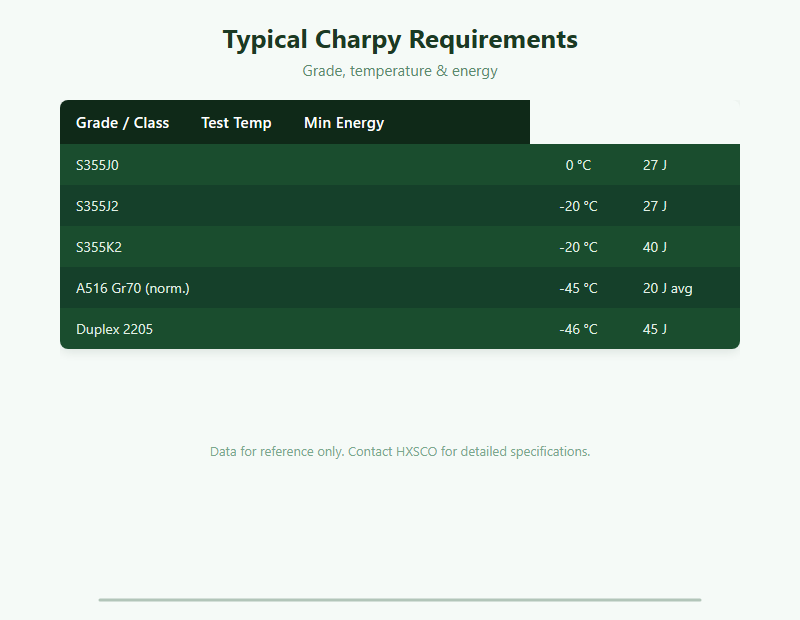
What the Test Measures
Toughness is the energy a material absorbs before fracture, and unlike Yield Strength Vs Tensile Strength it is strongly temperature dependent. The pendulum strikes a standard V-notched specimen; absorbed energy plus the fracture appearance (percentage shear, lateral expansion) tell you whether the break was ductile or brittle. Understanding the notch letters on structural steel — J0, J2, K2 — is essential when specifying our Steel Plate Supplier and Steel Bar Supplier material, and the base grades are set out in En 10025 Structural Steel and S355 Vs S275 Steel.
The Transition Temperature Trap
Body-centred-cubic steels show a sharp ductile-to-brittle transition: a plate absorbing 150 J at room temperature may absorb 10 J at −40 °C. Fine grain, normalising and low carbon push the transition down — the mechanisms are in Grain Structure Metals and Annealing Vs Normalizing. Austenitic stainless and aluminium have face-centred-cubic structures and no sharp transition, which is why cryogenic tanks use 304/316 or 5083; see Stainless Steel 316 Properties and 5083 Aluminum Properties. High-strength quenched grades and Maraging Steel Guide products trade some toughness for strength.
Specifying and Reporting
Always state three things: test temperature, minimum energy, and whether it is an average of three specimens or an absolute minimum. Specify the sampling direction (transverse is more demanding than longitudinal) and the position through thickness. Welded joints need the HAZ tested too, since heat input alters the microstructure — see Welding Consumables Guide and How To Weld Carbon Steel. Results appear on the certificate described in Mill Test Certificate Guide; sub-size specimens are permitted below 10 mm thickness with the energy pro-rated.
Get a Quote
Tell HXSCO your requirements and we will respond with a competitive quote and lead time.
Frequently Asked Questions
It is a pendulum test that measures the energy in joules absorbed when a notched 10x10x55 mm specimen fractures at a specified temperature, used to assess a material’s resistance to brittle fracture.
J2 means the steel must absorb at least 27 J in a Charpy V-notch test at −20 °C. J0 is 27 J at 0 °C and K2 is 40 J at −20 °C.
Carbon and low-alloy steels have a body-centred-cubic structure with a ductile-to-brittle transition; below it, cleavage fracture dominates and absorbed energy collapses.
Yes. HXSCO supplies plate, bar and pipe with Charpy V-notch impact testing at the temperature and energy level you specify, reported on the mill certificate.
Need Impact-Tested Steel?
HXSCO supplies structural and pressure-vessel steel with Charpy V-notch testing at your specified temperature and energy. Send grade, thickness and requirement for a quote.