


Short answer: Ring rolling deforms a heated pierced blank between a driven main roll and a pressure roll, expanding it into a seamless ring of precise diameter, wall and profile. Because the grain flows circumferentially, rolled rings give superior fatigue and impact strength over welded or machined rings, making them the standard for bearings, flanges, gears, turbine casings and heavy-wall pressure components.
At a Glance
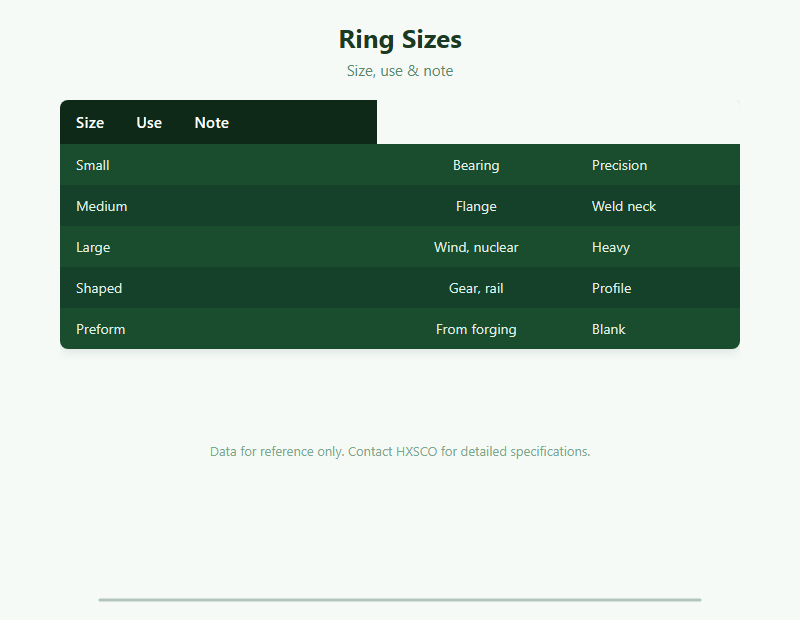
Ring Rolling Method
Ring rolling follows Forging Supplier and Metal Continuous Casting Guide; relate to Metal Grain Flow Guide and Metal Residual Stress Guide.
Quality
Profile and hardness checked by Metal Hardness Testing Methods, certified by Mill Test Certificate Guide, inspected by Metal Ndt Guide.
Supply & QA
Resist fatigue via Metal Vibration Fatigue Guide; finish via Metal Surface Treatment Guide. HXSCO supplies ring-rolling billet to spec.
Get a Quote
Tell HXSCO your requirements and we will respond with a competitive quote and lead time.
Frequently Asked Questions
Expanding a heated pierced blank into a seamless ring.
Circumferential grain flow gives better fatigue strength.
Bearings, flanges, gears, turbine and pressure parts.
From small precision bearings to multi-tonne heavy rings.
HXSCO supplies carbon, alloy and stainless billet for ring rolling.
Source Ring-Rolling Stock from HXSCO
HXSCO supplies carbon, alloy and stainless steel billet suited to seamless ring rolling. Send your grade and ring size for a quote.