


Short answer: Renewables depend on a short list of efficient metals: electrical steel for generators and transformers, copper for collectors and cabling, and aluminium or stainless for structures, each chosen for efficiency, weight and weather resistance rather than cost alone.
At a Glance
Electrical Steel for Power
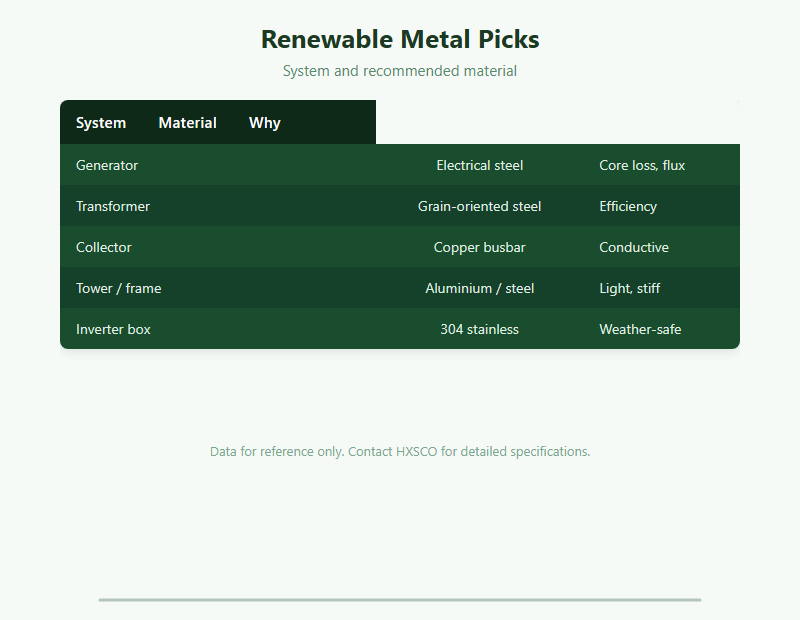
Generators and transformers live or die on core loss, so grain-oriented and non-oriented electrical steel earn their premium; the grades are in our Grain-Oriented Guide, Electrical Steel for Motors and for Transformers.
Copper for Collection
Collector rings and cabling need high conductivity, so copper busbars and wire dominate; the choice is in our Busbar Copper vs Aluminium and Copper vs Aluminium Wire guides, with conductivity basics in our Conductivity Guide.
Structures and Weathering
Towers and frames mix aluminium for weight and steel for stiffness, while逆变器 enclosures use 304 for weather; the trade-off is in our Aluminium vs Stainless and the corrosion view in our Corrosion Resistance Guide.
Magnets and Drivetrain
Direct-drive turbines use rare-earth magnets and specialty strips; our Rare-Earth Magnet Guide covers the materials and our Cobalt Alloy Supplier the alloys.
Sourcing for a Build
Project buyers bundle electrical steel, copper and structure metals into one RFQ with schedule; our How to Choose a Metal Supplier and Incoterms Guide cover the commercial side.
Get a Quote
Tell HXSCO your requirements and we will respond with a competitive quote and lead time.
Frequently Asked Questions
Non-oriented electrical steel for low core loss in motors.
For the lowest loss at high flux density.
Copper for conductivity; aluminium where weight matters.
304 stainless or coated steel for weather safety.
We supply electrical steel, copper and structure metals; send the BOM.
Source Renewable-Energy Metal from HXSCO
HXSCO supplies electrical steel, copper and structure metals for solar, wind and hydro with mill certificate. Send your bill of materials for a quote.