



Short answer: Malleable iron is white iron annealed for many hours so temper-carbon nodules form, giving useful ductility and shock resistance for fittings and brackets; the family is compared in our Cast Iron Guide and supply in our Cast Iron Supplier page.
At a Glance
From White Iron to Malleable
Malleable iron starts as white iron and is annealed to decompose carbides into temper carbon; the starting structure is explained in our White Iron Guide.
Blackheart, Whiteheart and Pearlitic
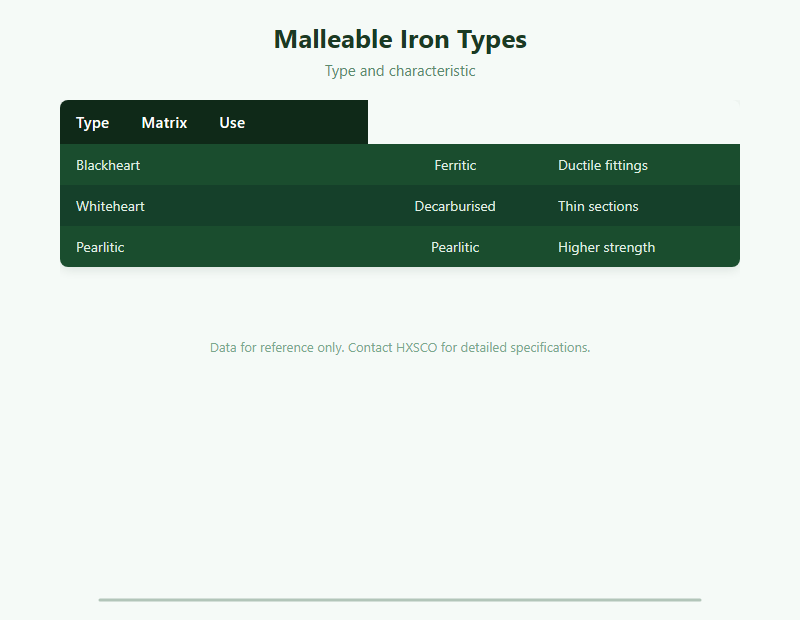
Blackheart is ferritic and ductile, whiteheart is decarburised for thin walls, pearlitic is stronger; the heat-treatment basis is in our Metal Heat Treatment Guide.
Malleable vs Ductile Iron
Malleable needs a long anneal and suits thinner sections; ductile is made directly; compare in our Ductile Iron Guide.
Typical Applications
Pipe fittings, clamps, brackets and hardware; the process context is in our Metal Casting Guide and the corrosion care in our Surface Treatment Guide.
Quality and Inspection
Anneal consistency and decarburisation depth are checked per our Quality Inspection Guide; defects are covered in our Casting Defects Guide.
Ordering Notes
Specify type, grade, section thickness and quantity; price with our Price Quotation Guide.
Get a Quote
Tell HXSCO your requirements and we will respond with a competitive quote and lead time.
Frequently Asked Questions
Because annealing makes the originally brittle casting ductile.
Blackheart for ductility, whiteheart for thin sections.
Often tens of hours, controlled by cycle.
Yes – especially for pipe fittings and hardware.
Yes – to grade and drawing.
Get a Malleable Iron Quote
HXSCO supplies blackheart, whiteheart and pearlitic malleable iron fittings and castings with certificates. Send your specification for a quote.