


Short answer: Motor rotors and stators are built from non-grain-oriented electrical steel (NOES / CRNGO) because the flux rotates, needing uniform magnetic properties in every direction. Premium IE4/IE5 motors use thin 0.35 mm grades (35W230–35W310); general IE2/IE3 motors use 0.50 mm (50W400–50W600); EV traction uses 0.20–0.35 mm to cut high-frequency loss. Generators use similar NOES grades.
At a Glance
Why Motors Use NOES
In a motor the flux rotates through the iron every cycle, so the material must behave the same in all directions. Non-grain-oriented electrical steel is isotropic, making it the right choice for rotors and stators. GOES would be a poor fit because its advantage exists only along one axis.
Grade by Efficiency Class
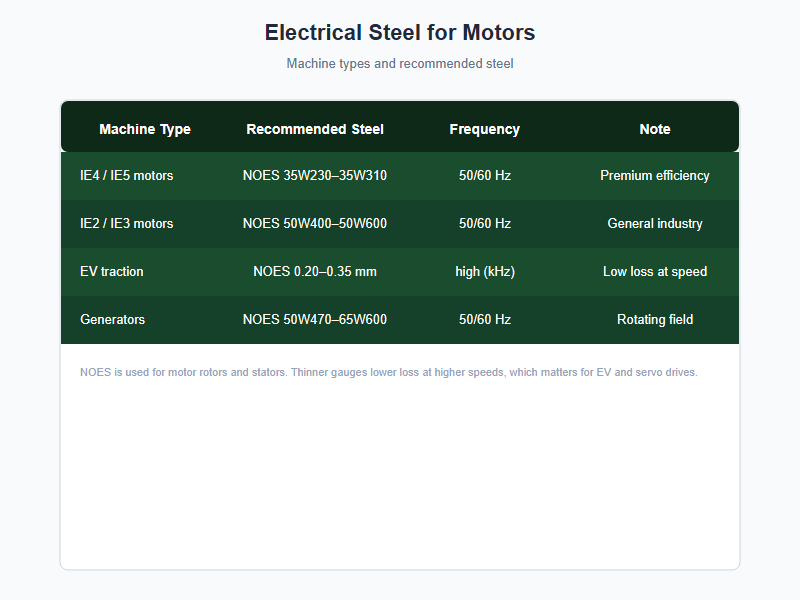
The chart above links machine type to grade. IE4/IE5 premium motors use thin 0.35 mm NOES (35W230–35W310) for the lowest loss. IE2/IE3 general motors use 0.50 mm (50W400–50W600). EV traction uses very thin 0.20–0.35 mm to reduce loss at kilohertz switching frequencies. Generators use 0.50–0.65 mm NOES for the rotating field.
Loss, Frequency, and Stacking
Core loss rises with frequency and flux density, so high-speed and EV drives need thinner, lower-loss gauges. A high stacking factor (tight, flat laminations with intact coating) maximizes the usable steel and keeps efficiency up. Bondable C5 coatings let you build rigid lamination stacks without rivets.
Stamping and Assembly
- Progressive dies stamp rotors and stators from NOES strip at volume.
- Laser cutting suits prototypes and low runs without tooling.
- Coating care after cutting preserves inter-laminar resistance.
- Annealing can restore magnetic properties after heavy work.
Sourcing Motor Steel from HXSCO
HXSCO supplies non-grain-oriented electrical steel for motor laminations — see our non-grain-oriented electrical steel product page. Send the motor class, grade, thickness, coating, and width, and we will slit and quote with mill-test certificates. For transformer cores, also see our grain-oriented electrical steel.
Frequently Asked Questions
Non-grain-oriented electrical steel (NOES / CRNGO) is used because the rotating flux needs uniform magnetic properties in all directions.
Premium IE4/IE5 motors use thin 0.35 mm NOES such as 35W230–35W310 for the lowest core loss.
EV drives switch at high frequency, so thinner 0.20–0.35 mm NOES reduces eddy-current and excess loss at speed.
Yes. Laser cutting suits motor prototypes and low runs without die tooling; just keep the coating intact to preserve inter-laminar resistance.
General IE2/IE3 motors typically use 0.50 mm NOES (50W400–50W600); large machines and appliances use 0.50–0.65 mm.
Ready to source electrical steel?
Tell us the type (GOES or NOES), grade, thickness, coating class, width/length, and quantity. HXSCO will reply with a competitive quote, lead time, and mill-test options.
Request a QuoteWhy Transformer & Motor Makers Source Electrical Steel from HXSCO
HXSCO supplies both grain-oriented electrical steel (GOES / CRGO) and non-grain-oriented electrical steel (NOES / CRNGO) in coil and sheet for transformer, motor, and generator manufacturers. We stock standard grades (23Q/27Q/30Q GOES, 35W/50W/65W NOES), supply with insulating coating and mill-test certificates, and cut or slit to your lamination width. Contact HXSCO for a project-specific quote or grade recommendation.