


Short answer: Most weld defects trace to four root causes — contamination, wrong heat input, poor technique and hydrogen — so porosity, lack of fusion, undercut, slag inclusions and cracks are prevented by clean joints, correct amperage and travel speed, dry low-hydrogen consumables and controlled preheat.
At a Glance
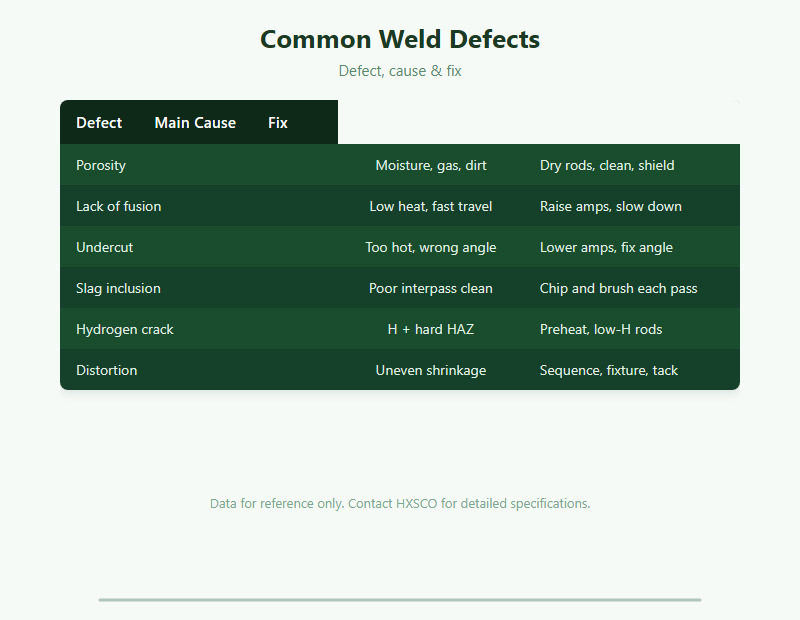
Volumetric Defects: Porosity and Inclusions
Porosity is trapped gas — from moisture in the electrode coating, oil or rust on the plate, or a shielding-gas failure such as too little flow, a draught, or a blocked nozzle. The cure is boring and effective: bake or vacuum-pack consumables per Welding Consumables Guide, grind the joint clean, and verify gas flow. Slag inclusions come from failing to chip and wire-brush between passes, or from a joint geometry too narrow to let slag float out. Both show clearly on radiography or ultrasonics, as described in Metal Ndt Guide.
Geometric Defects: Fusion, Undercut and Penetration
Lack of fusion is the dangerous one, because a weld can look perfect and carry almost no load where the bead never bonded to the sidewall. It comes from too little heat, excessive travel speed, a wrong electrode angle or an unsuitable joint preparation — and it is the flaw that ultrasonic inspection exists to find. Undercut is a groove melted into the base metal beside the toe, caused by excess current or a bad angle, and it acts as a fatigue notch exactly as Metal Fatigue Endurance Limit predicts. Incomplete penetration leaves the root unfused, and excess spatter plus a rough profile raise measured roughness in the way Surface Roughness Ra Guide describes. Practice for each family is in How To Weld Carbon Steel, How To Weld Stainless Steel and How To Weld Aluminum.
Cracks and Distortion
Hydrogen (cold) cracking appears hours or days after welding, when dissolved hydrogen collects in a hard heat-affected zone under residual stress — the mechanism in Metal Hydrogen Embrittlement Guide. Prevent it with preheat set from the carbon equivalent per Steel Carbon Equivalent Guide, low-hydrogen consumables and controlled interpass temperature. Solidification (hot) cracking hits high-sulphur steel and some aluminium alloys as the bead freezes; fix by consumable choice and bead shape. Sensitisation in stainless steel is not a crack but a corrosion trap, explained in Intergranular Corrosion Stainless.
Distortion is uneven shrinkage, not a flaw in the metal — control it with balanced sequencing, back-step welding, fixtures and post-weld Stress Relieving Vs Annealing. Joining unlike metals brings its own crack modes, covered in Dissimilar Metal Welding Guide.
Get a Quote
Tell HXSCO your requirements and we will respond with a competitive quote and lead time.
Frequently Asked Questions
Porosity, lack of fusion, undercut, slag inclusion, incomplete penetration, hydrogen cracking and distortion are the most common weld defects.
Trapped gas from moisture in electrodes, oil, rust or paint on the joint, or shielding-gas problems such as low flow, draughts or a blocked nozzle.
Because the weld can look sound while carrying almost no load where the bead failed to bond to the sidewall. It is usually found only by ultrasonic or radiographic inspection.
Preheat according to carbon equivalent and thickness, use dry low-hydrogen consumables, control interpass temperature, and inspect at least 48 hours after welding since the cracking is delayed.
Yes. HXSCO supplies welded assemblies with UT, RT, MT or PT inspection and mill certificates on request.
Source Inspected Weldments from HXSCO
HXSCO fabricates welded assemblies with qualified procedures, low-hydrogen consumables and UT/RT/MT inspection. Send your drawing, code and quantity for a quote.