


Short answer: Tool steels are high-carbon, alloyed steels built to cut, form, or shape other materials. They split into water-hardening (W), cold-work (A/D), hot-work (H), high-speed (M/T), and shock-resisting (S) classes. Choose by operating temperature, wear, and shock: cold-work for dies, hot-work for forging, high-speed for cutting tools that stay hard when hot.
At a Glance
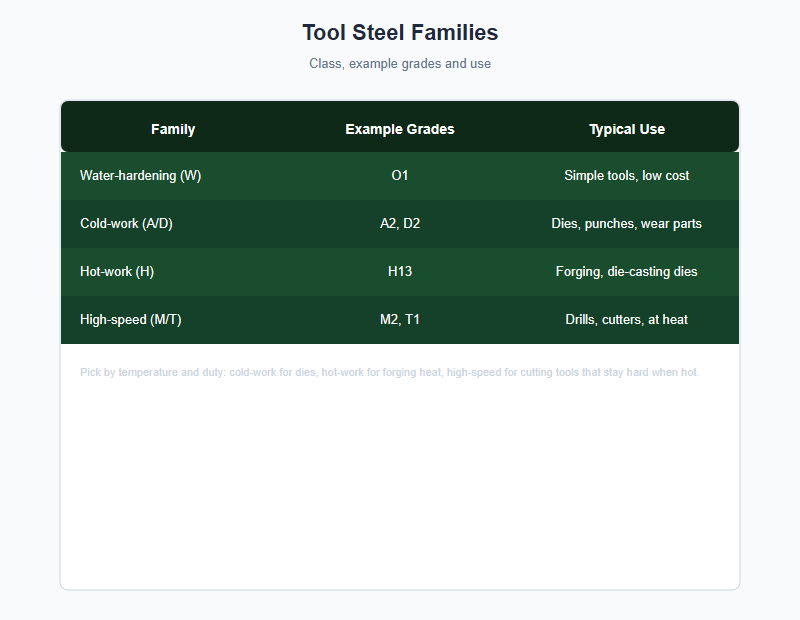
The Five Tool-Steel Families
The chart groups the main classes. Water-hardening (W) steels like O1 are cheap and simple but distort easily. Cold-work (A/D) air- and oil-hardening grades (D2, A2) resist wear in dies and punches. Hot-work (H) grades survive forging and die-casting heat. High-speed (M/T) steels keep hardness at cutting temperatures. Shock-resisting (S) grades absorb impact.
Wear, Toughness, and Heat
Trade-offs rule selection: D2 maximizes wear resistance but is brittle; A2 balances wear and toughness; H13 is the hot-work default for dies that see repeated heating; M2 stays hard enough to cut at red heat. Match the class to temperature, abrasion, and shock in your process.
Related Carbon and Alloy Steels
Not every tool needs tool steel. For many structural and machining jobs, understanding alloy steel or specifying stainless bar may be the better, lower-cost route. HXSCO can advise on the right grade for your tool or part.
Sourcing Tool Steel from HXSCO
Tell HXSCO the tool-steel class, grade, form, and dimensions you need (round, flat, or block) with heat-treatment and certification requirements, and we will quote with mill-test documentation.
Frequently Asked Questions
Water-hardening (W), cold-work (A/D), hot-work (H), high-speed (M/T), and shock-resisting (S) classes, each tuned for temperature, wear, or impact.
Cold-work steels (A2, D2) serve room-temperature dies and punches; hot-work steels (H13) resist softening and cracking under forging or die-casting heat.
High-speed steels (M2, T1) stay hard at the heat generated by cutting, so they are used for drills, end mills, and saw blades.
Yes. D2 is a high-carbon, high-chromium cold-work steel with excellent wear resistance, at the cost of lower toughness than A2.
Give the class/grade, form (round, flat, block), dimensions, heat treatment, and any certification; HXSCO will quote with mill-test records.
Ready to source Tool Steel Types Guide from HXSCO?
Send us the grade, form, dimensions, quantity, and any certification or test requirements. HXSCO replies with a competitive quote, lead time, and mill-test options.
Request a Quote