


Short answer: Stainless steel prices are driven mainly by alloy cost (nickel and chromium), the grade, thickness/weight, surface finish, order quantity, and any cutting or processing. 316 typically costs 20–40% more than 304. Always compare a full quote that includes material, processing, packing, and freight — not just price per kilogram.
At a Glance
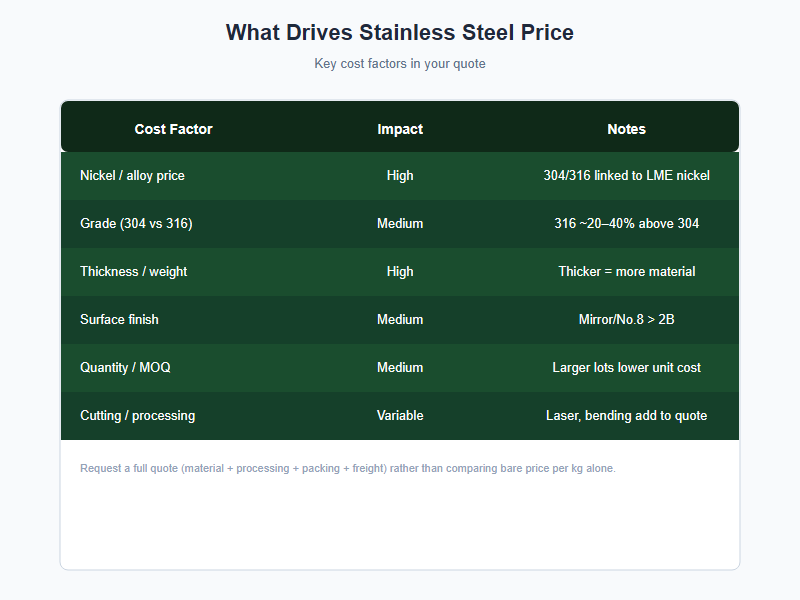
Raw Material and Alloy Cost
The largest single driver is the alloy content. 304 and 316 prices track the LME nickel price because both contain significant nickel. When nickel rises, so do stainless quotes. Molybdenum in 316 adds further cost.
Grade Choice
Choosing the grade sets the baseline. 430 (no nickel) and 201 (low nickel, high manganese) are cheaper than 304. 316 carries a 20–40% premium over 304 for its molybdenum. Duplex and specialty grades cost more but can save weight through higher strength.
If your environment allows, stepping down from 316 to 304 plate or from 304 to 430 plate can materially lower cost without hurting performance.
Thickness, Finish, and Quantity
Heavier sections use more material, so thickness and weight directly raise price. Mirror (No.8) and colored finishes cost more than standard 2B. Larger, repeated orders lower the unit price through better mill utilization and shared freight.
Processing and Packing
Cutting, laser cutting, bending, and slitting add processing cost but often beat doing it in-house. Export packing (wooden crates, VCI paper, edge protection) protects the material and is worth including in the quote.
How to Get an Accurate Quote
Send HXSCO the grade, size, finish, tolerance, quantity, and destination. Ask for a single quote covering material + processing + packing + freight so you can compare like-for-like. Request your quote here.
Frequently Asked Questions
316 contains molybdenum and usually more nickel, and both metals are priced on global markets. The premium is typically 20–40%.
Mainly the LME nickel price, plus chromium and molybdenum costs, energy, and mill demand. Prices can move weekly.
Per piece, yes, because it uses more material. But per kilogram the price is similar, so compare by weight and by the finished part cost.
Right-size the grade to the environment, standardize sizes, increase order quantity, and let HXSCO do cutting to avoid scrap and in-house processing.
No. Compare the full quote: material, finish, processing, packing, and freight. A slightly higher kg price with free cutting can be cheaper overall.
Ready to source stainless steel?
Tell us the grade, size, quantity, and destination. HXSCO will reply with a competitive quote, lead time, and mill-test options.
Request a QuoteWhy Buyers Trust HXSCO for Stainless Steel
HXSCO is a stainless steel supplier serving manufacturers, fabricators, and trading companies worldwide. We stock 304, 304L, 316, 316L, 430, 201, and duplex grades in plate, sheet, coil, pipe, tube, bar, wire, and rod forms. Every order can be supplied with mill-test certificates, third-party inspection, and custom cutting/shearing to your drawing. Contact HXSCO for a project-specific quote or material recommendation.