


Short answer: Spring steel is high-carbon or low-alloy steel engineered to return to its original shape after significant deformation. Key grades include carbon spring steel (65Mn, 1065, 1075, 1095) and alloy spring steel (51CrV4/6150, 60Si2Mn/9260, 50CrV4/6150), used in automotive suspension, machinery, and precision instruments.
At a Glance
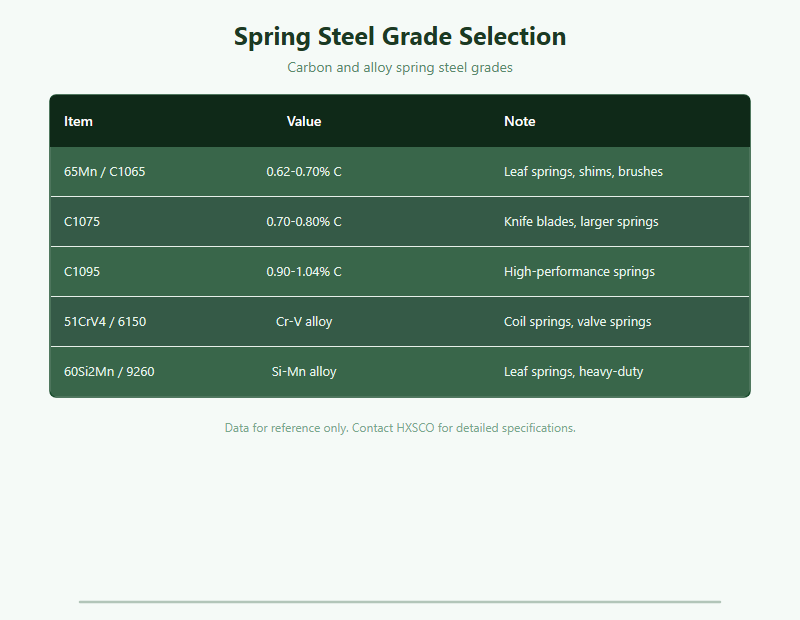
Carbon Spring Steels
| Grade | Carbon % | Hardness (as-quenched) | Typical Uses |
|---|---|---|---|
| 65Mn / C1065 | 0.62–0.70 | 57–62 HRC | Leaf springs, shims, brushes |
| C1075 | 0.70–0.80 | 58–63 HRC | Knife blades, larger springs |
| C1095 | 0.90–1.04 | 60–64 HRC | High-performance springs, saw blades |
Carbon spring steels are economical and achieve high hardness through quenching and tempering. They offer good fatigue resistance for static or moderate-cycle applications but have limitations in high-temperature or high-impact service.
Alloy Spring Steels
| Grade | Key Alloy | Advantage | Uses |
|---|---|---|---|
| 51CrV4 / 6150 | Cr-V | Deep hardenability, toughness | Coil springs, valve springs |
| 60Si2Mn / 9260 | Si-Mn | High elastic limit, shock load | Leaf springs, tines, heavy-duty |
| 50CrV4 / 6150 | Cr-V | Fatigue + creep resistance | Hot-coiled springs, engine valves |
Alloy additions improve hardenability (through-hardening in thicker sections), fatigue strength, and resistance to permanent set. See tool steel options for applications requiring wear resistance beyond spring properties.
Spring Steel Forms Available
HXSCO supplies spring steel in:
- Strip / Coil: 0.1–6 mm × up to 600 mm width, annealed, hardened & tempered, or skin-passed
- Flat Bar: 3–50 mm thickness, cold-drawn or hot-rolled
- Round Bar: Ø 4–100 mm, peeled, ground, or polished
- Wire: Ø 0.1–16 mm, patented, oil-tempered, or music wire quality
Heat Treatment Basics
Spring manufacturing follows: (1) Forming in annealed condition → (2) Austenitizing (780–880°C depending on grade) → (3) Quenching (oil or polymer) → (4) Tempering (350–500°C to target hardness) → (5) Shot peening (improves fatigue life 20–60%) → (6) Optional presetting/stress-relief.
Final hardness for most springs falls in 44–58 HRC depending on the application — harder for static loads, slightly softer for high-cycle fatigue service.
Get a Quote
Tell HXSCO your requirements and we will respond with a competitive quote and lead time.
Frequently Asked Questions
1095 has higher carbon (0.95–1.04%) giving greater maximum hardness (up to 64 HRC) and edge retention. 1075 (0.70–0.80% C) is tougher and easier to forge/grind. 1095 for cutting tools; 1075 for larger springs and knives needing more toughness.
Welding spring steel is challenging — the heat-affected zone loses its heat treatment. Use compatible filler, preheat to 200–300°C, and plan for post-weld re-heat-treatment. For critical springs, avoid welding entirely; use mechanical fastening instead.
Alloy spring steel (like 6150 Cr-V or 9260 Si-Mn) offers deeper hardening for thicker sections, better fatigue resistance under cyclic loading, and improved performance at elevated temperatures. Carbon steel is fine for thin sections and moderate-duty applications.
Shot peening bombards the spring surface with round media (steel/glass shot), creating compressive residual stress. This dramatically improves fatigue life (often doubling it) by resisting crack initiation — essential for automotive suspension and engine valve springs.
Stock strip and wire are available from 50 kg. Custom heat-treated sizes and grades typically require 500 kg minimum. Contact us with your specifications.
Need Spring Steel?
HXSCO supplies carbon and alloy spring steel in strip, coil, bar, and wire forms — annealed, hardened & tempered, or ground. Send us your grade, size, quantity, and technical requirements.