


Short answer: Friction welding joins parts by rubbing them together under force until the interface plasticises from heat, then forging the softened surfaces into a solid-state bond with no filler, flux or melt — producing a clean, full-strength joint with minimal heat-affected zone. Spin friction welding joins round parts end-to-end, upset (linear) friction welding joins bars and non-round sections, and radial friction welding attaches collars or flanges to tube; all are favoured for dissimilar-metal joints and high-integrity shafts where fusion welding would dilute or crack.
At a Glance
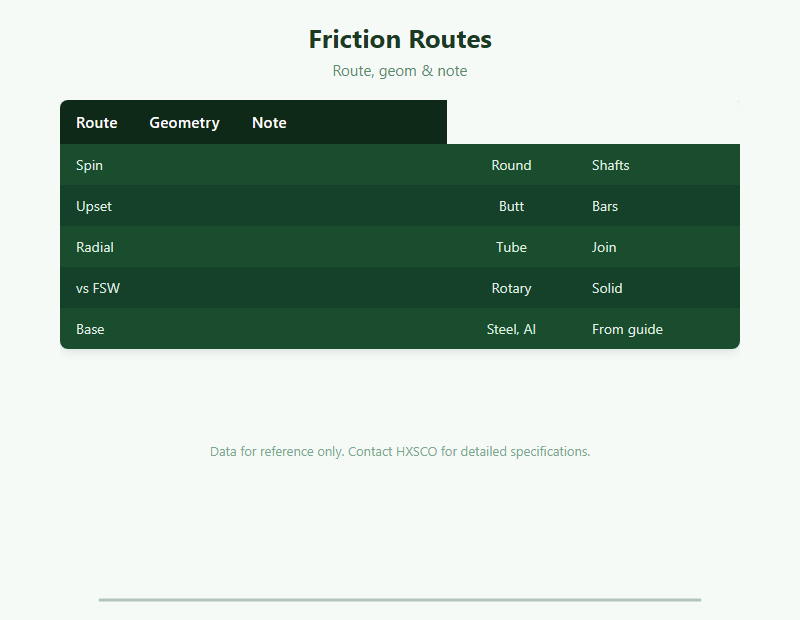
Friction vs Other Welding
Friction welding compares with Metal Friction Stir Welding Guide, Metal Resistance Welding Guide and Metal Laser Welding Guide; relate to Metal Adhesive Bonding Guide.
Quality
Joint and flash checked by Metal Ndt Guide, documented per Mill Test Certificate Guide. Relate to Metal Welding Positions Guide and Metal Heat Affected Zone Guide.
Supply & QA
Match alloys via Stainless Steel Grades Explained; HXSCO supplies friction-weldable bar and tube.
Get a Quote
Tell HXSCO your requirements and we will respond with a competitive quote and lead time.
Frequently Asked Questions
Heat by rubbing + forging, no melt or filler.
Spin joins round ends; upset joins bars/non-round butts.
Both solid-state; friction is rotary/upset, FSW is stirred.
Yes — great for joining incompatible alloys.
HXSCO supplies bar and tube suited to friction welding.
Source Friction-Weldable Stock from HXSCO
HXSCO supplies steel, stainless and aluminium bar and tube suited to friction welding. Send your alloy and size for a quote.