


Short answer: Medical devices use titanium and 316LVM stainless for implants, hardenable stainless for instruments and nickel alloys for electrodes, so buyers meet biocompatibility and cleanliness rules; our Titanium Supplier and Corrosion Resistance Guide give the supporting detail.
At a Glance
Implants and Biocompatibility
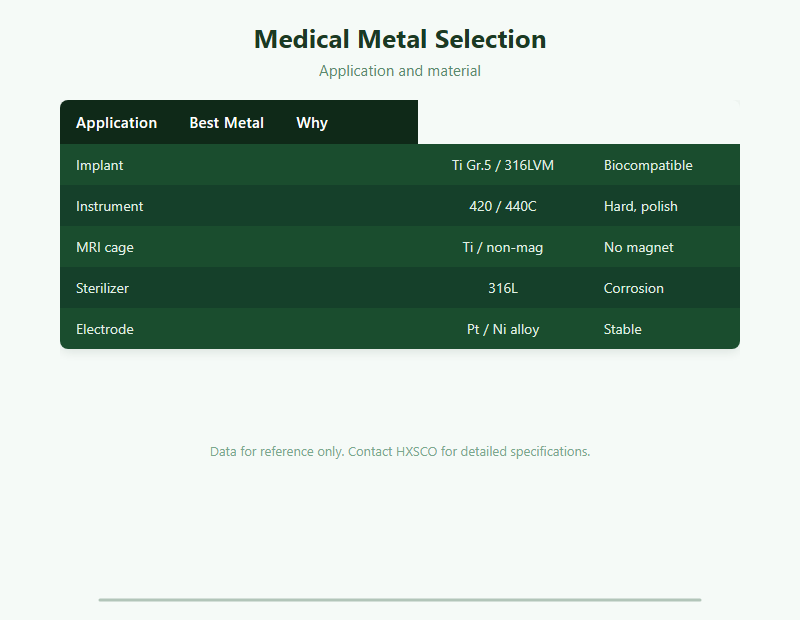
Implants use Titanium Supplier grades and Stainless Steel Supplier 316LVM, with corrosion notes in our Corrosion Resistance Guide.
Instruments and Hardness
Surgical instruments use Tool Steel Supplier grades and hardenable stainless, with methods in our Heat Treatment Guide; a quick spec summary is below.
| Part | Grade | Hardness |
|---|---|---|
| Implant | Ti Gr.5 | Biocompatible |
| Scalpel | 440C | 58 HRC |
| Tray | 316L | Corrosion |
Cleanliness and Certification
Medical lots need traceability, with tests in our Quality Inspection Guide and certification in our Mill Test Certificate Guide.
Procurement Tips
Share the device class and standard, and pack clean with our Export Packing Guide.
Get a Quote
Tell HXSCO your requirements and we will respond with a competitive quote and lead time.
Frequently Asked Questions
Titanium Grade 5 and 316LVM stainless.
420 and 440C hardenable stainless.
Yes – titanium is non-magnetic.
316L resists pitting and body fluids.
Yes – full traceability and material certs.
Supply Medical Metals from HXSCO
HXSCO supplies titanium, 316LVM stainless, cobalt chrome and nickel alloys for medical devices. Send grade, standard and quantity for a quote.