


Short answer: Anisotropy is the directional variation of a metal’s properties after rolling or forging — strength and toughness run higher along the working direction while ductility and formability can fall across it, so orientation must be chosen at design time.
At a Glance
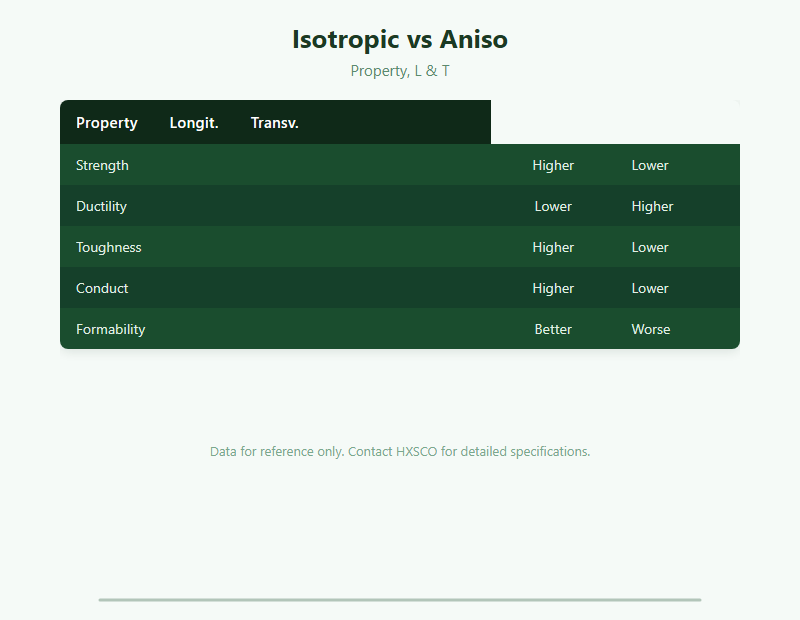
Directional Properties
Rolling aligns grains and inclusions, so longitudinal beats transverse; relate to Metal Formability Guide, Metal Springback Guide and Metal Strain Hardening Guide. See Grain Structure Metals.
Design Rules
Orient the tough direction across the load; for sheet use Cold Rolling Vs Hot Rolling and Metal Deep Drawing Guide; machine per Metal Machinability Guide.
QA & Supply
Document orientation per Mill Test Certificate Guide and protect via How To Prevent Metal Rust. HXSCO supplies stock cut to the right grain direction.
Get a Quote
Tell HXSCO your requirements and we will respond with a competitive quote and lead time.
Frequently Asked Questions
Properties that vary with direction because of rolling or forging texture.
Usually the longitudinal (working) direction.
Inclusions and grain flow weaken across the working direction.
Orient the tough axis across the main load and specify grain direction.
HXSCO supplies stock cut to the grain direction your design needs.
Source Direction-Oriented Metal from HXSCO
HXSCO supplies metal cut to the grain direction your strength and formability targets need. Send your spec and quantity for a quote.