


Short answer: Steel is specified by regional standards – ASTM (USA), EN (Europe), DIN (Germany), JIS (Japan), and GB (China). Each defines grade, chemistry, mechanical properties, and test methods. Knowing which system your project uses prevents costly mismatches; HXSCO cross-references and supplies to all major standards.
At a Glance
Why Standards Matter
A standard is the contract behind a purchase order: it fixes chemistry, strength, toughness, dimensions, and testing. Ordering ‘steel’ without a standard invites the wrong grade. Specifying the correct system (and equivalent) ensures the material performs and passes inspection anywhere in the world.
The Major Systems Compared
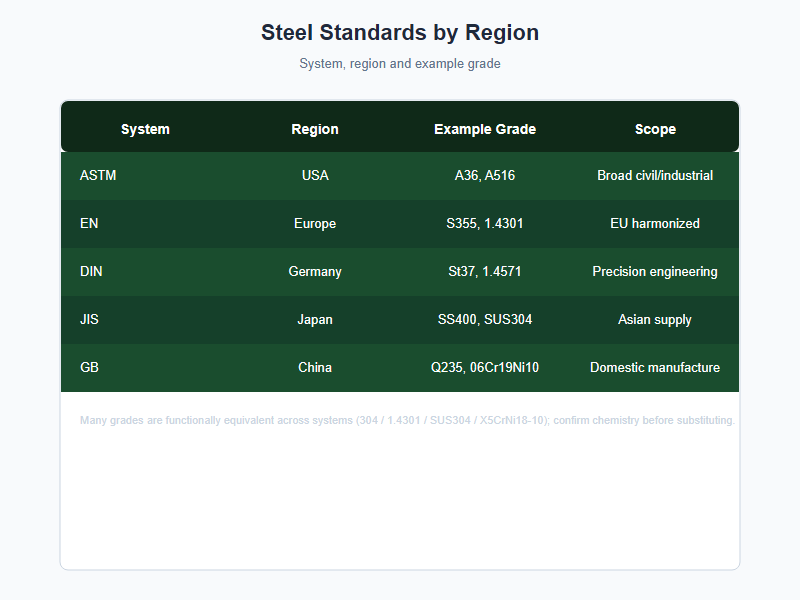
The chart contrasts the big five. ASTM (USA) uses A/SA designations (A36, A516). EN (Europe) uses numeric grades (S355). DIN (Germany) is the historic precision system (St37, 1.4301). JIS (Japan) drives Asian supply (SS400, SUS304). GB (China) is the domestic manufacturing standard. HXSCO links all of these on our standards pages.
Cross-Referencing Grades
Many grades are functionally equivalent across systems – for example SUS304 (JIS), 1.4301 (DIN), X5CrNi18-10 (EN), and 304 (ASTM) are the same austenitic stainless. See our ASTM/ASME carbon-steel standards page, plus the DIN, BS, JIS, and EN references, to map your specification.
Specifying Standards for Your Order
State the standard, grade, and any supplementary requirements (impact test, ultrasonic, NACE) on your enquiry. Tell HXSCO the standard and grade and we will quote with the correct mill certificates and approvals.
Frequently Asked Questions
ASTM (USA), EN (Europe), DIN (Germany), JIS (Japan), and GB (China) – each defining grade, chemistry, properties, and testing.
Many are functionally equivalent (e.g. 304, 1.4301, SUS304, X5CrNi18-10), but always confirm chemistry and mechanicals before substituting.
A36 is a common US structural carbon steel with a minimum yield of 250 MPa, widely used for plates and shapes.
The standard fixes chemistry, strength, and testing, preventing the wrong grade and ensuring the material passes inspection.
Yes. HXSCO cross-references and supplies to ASTM, EN, DIN, JIS, and GB with the relevant mill-test certificates.
Ready to source ASTM, EN, DIN & JIS Steel Standards from HXSCO?
Send us the grade, form, dimensions, quantity, and any certification or test requirements. HXSCO replies with a competitive quote, lead time, and mill-test options.
Request a Quote