


Short answer: Choose 5052-H32 for marine, chemical tank, and sheet metal applications requiring excellent corrosion resistance and formability. Choose 6061-T6 for structural, machining, and high-strength applications where heat treatability matters more than max corrosion resistance.
At a Glance
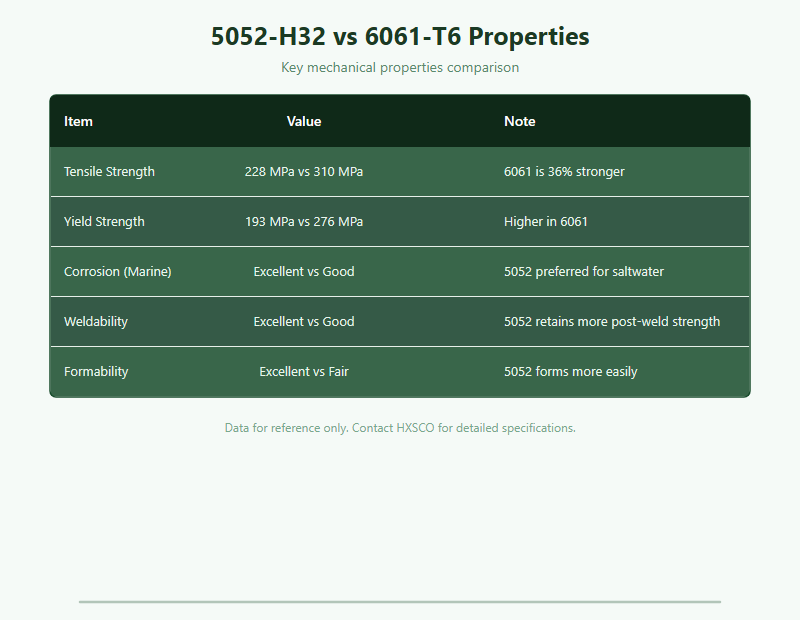
Core Properties Comparison
| Property | 5052-H32 | 6061-T6 |
|---|---|---|
| Tensile Strength | 228 MPa | 310 MPa |
| Yield Strength | 193 MPa | 276 MPa |
| Elongation | 12% | 12% |
| Corrosion (salt spray) | Excellent | Good |
| Weldability | Excellent | Good (loses strength at weld) |
| Machinability | Fair | Good |
| Formability | Excellent | Fair |
| Heat Treatable | No (work-hardening only) | Yes (precipitation hardening) |
When to Use 5052-H32
5052 is an Al-Mg alloy (2.5% Mg) known for outstanding corrosion resistance, especially in marine and chemical environments:
- Marine hardware: Hull panels, decks, superstructures, boat trailers. See also marine grade aluminum guide.
- Chemical storage tanks: Fuel tanks, hydraulic reservoirs, chemical process vessels.
- Sheet metal fabrication: Enclosures, cabinets, ductwork, signage — excellent for forming and bending.
- Automotive: Fuel lines, body panels, sound deadening.
5052 retains most of its strength after welding — a major advantage over 6061 for fabricated assemblies.
When to Use 6061-T6
6061 is an Al-Mg-Si alloy that responds well to heat treatment, making it the go-to structural aluminum:
- Structural frames: Machine bases, support structures, trailer frames, scaffolding.
- CNC machining: Automotive parts, robotics components, fixtures, tooling plates. Compare with 7075 for higher strength needs.
- Pipe and tube: Structural tubing, bicycle frames, roll cages.
- Mold making: Low-volume injection molds, blow molds, jigs and fixtures.
Note: welding 6061-T6 reduces strength in the heat-affected zone to roughly T4 properties (~240 MPa tensile). Post-weld heat treatment can partially recover this.
Cost Considerations
5052 is generally 5–15% less expensive than 6061 per kilogram due to simpler processing (no heat treatment). However, 6061’s higher strength may allow thinner gauges, potentially offsetting the material cost difference in weight-sensitive designs.
Get a Quote
Tell HXSCO your requirements and we will respond with a competitive quote and lead time.
Frequently Asked Questions
Yes, using 5356 filler rod produces acceptable results. However, the dissimilar joint will have properties closer to the weaker alloy (5052) in the weld zone. Design accordingly.
5052 is strongly preferred for below-waterline and exposed marine applications due to superior saltwater corrosion resistance. 6061 is acceptable for interior structural components kept dry.
No — 5052 is strengthened by work-hardening (H32 = strain-hardened, stabilized). It cannot be heat-treated like 6061.
Both anodize well. 5052 produces clear, natural-gray finishes. 6061 can show slight darkening but accepts dyes evenly. Both are popular for architectural anodizing.
6061-T6 is significantly stronger: 310 MPa tensile vs 228 MPa for 5052-H32 — about 36% stronger. Use 6061 when strength drives the design.
Choosing Between 5052 and 6061?
Not sure which alloy fits your project? Share your application, loads, environment, and budget with HXSCO. Our metallurgists recommend the optimal grade and supply it from stock.