


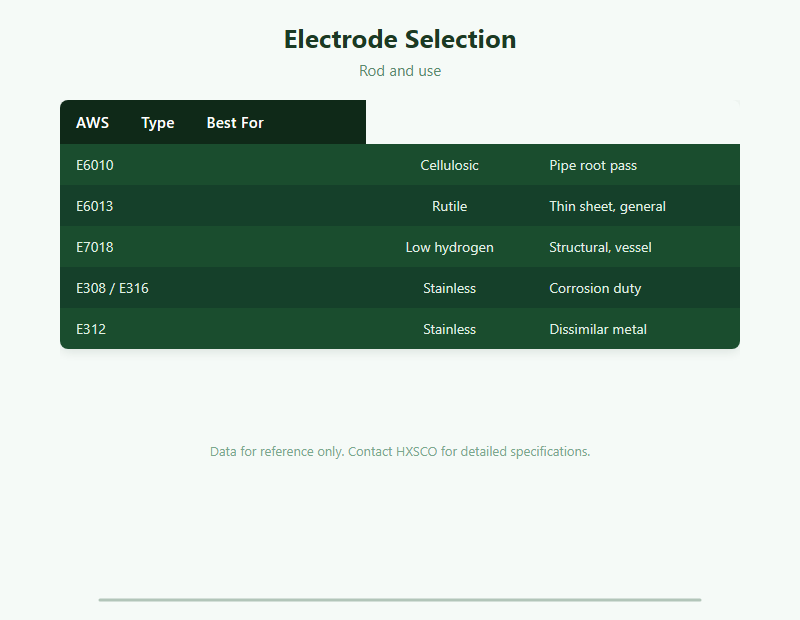
Short answer: Stick welding electrode selection follows the job: E6010 for pipe roots, E6013 for thin sheet, low-hydrogen E7018 for structural and pressure welds and stainless E308 or E316 for corrosion service; supply in our Welding Electrode Supplier and the overview in our Metal Welding Guide.
At a Glance
How Electrodes Are Classed
The AWS number encodes tensile strength, position and coating, with the joint context in our Dissimilar Metal Welding Guide and base metals in our Carbon Steel Supplier.
Cellulosic and Rutile
E6010 digs deep for pipe roots and E6013 is forgiving on thin sheet and dirty steel, with setup in our How to Weld Carbon Steel guide.
Low-Hydrogen E7018
E7018 controls hydrogen to stop cracking in structural and pressure work; keep it dry and verified with our Quality Inspection Guide.
Stainless and Exotic Rods
E308 and E316 cover corrosion duty and E312 bridges dissimilar joints, with alloy notes in our Stainless Steel Buyers Guide.
Certification
Buy lots with MTC covering deposit chemistry and Charpy impact, documented per our Mill Test Certificate Guide.
Get a Quote
Tell HXSCO your requirements and we will respond with a competitive quote and lead time.
Frequently Asked Questions
Pipe root passes thanks to deep penetration.
Structural and pressure welds needing low hydrogen.
Yes – easy arc, good on thin sheet.
E308 for 304, E316 for 316 duty.
To avoid hydrogen cracking.
Get Stick Electrode Quote
HXSCO supplies stick electrodes from E6010 to E7018 and stainless grades with MTC. Send grade, diameter and quantity for a quote.