


Short answer: Non-grain-oriented electrical steel (NOES, also called CRNGO) has randomly oriented grains, so its magnetic properties are uniform in every direction. That makes it ideal for rotating machines — motors, generators, and EV traction drives. Common grades run 0.20–0.65 mm thick, with core loss from about 2.3 W/kg (35W230) to 6.0 W/kg (50W600/65W600) at 1.5 T, 50 Hz.
At a Glance
What Is Non-Grain-Oriented Electrical Steel?
NOES is a silicon-iron alloy (0.5–3.5% silicon) rolled without a preferred grain direction. Because magnetization is similar in all directions, it performs well where the flux rotates and reverses — exactly what happens in a motor rotor and stator. Lower silicon gives higher flux density; higher silicon lowers loss but reduces ductility.
NOES Grades and Core Loss
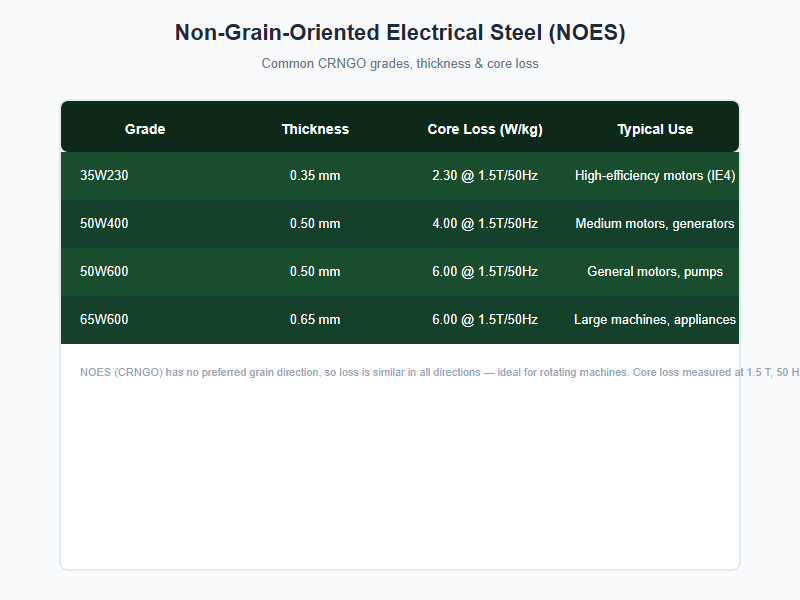
The chart above shows representative grades. High-efficiency motors (IE4/IE5) use thin 0.35 mm material with loss around 2.3–3.1 W/kg; general IE2/IE3 motors use 0.50 mm grades (50W400–50W600); large machines and appliances use 0.50–0.65 mm. Loss is quoted at 1.5 T and 50 Hz. Thinner gauges reduce loss at higher speeds (EV, servo).
Coating and Punchability
NOES carries an insulating coating (often C3/C4 or a bondable C5) that prevents eddy currents between laminations. Good punchability matters because millions of laminations are stamped; consistent coating and flatness keep die wear low and stacks tight. Ask for the coating class suited to your stamping and bonding process.
Applications
- Motors: Rotors and stators for IE2–IE5 machines.
- EV traction: Thin 0.20–0.35 mm NOES for low high-frequency loss.
- Generators: Rotating-field cores.
- Appliances & pumps: Cost-effective 0.50–0.65 mm grades.
Sourcing NOES from HXSCO
HXSCO stocks non-grain-oriented electrical steel in coil and sheet — see our non-grain-oriented electrical steel product page. Send the grade, thickness, coating class, and width, and we will slit, cut, and quote with mill-test certificates. For transformer cores, also see our grain-oriented electrical steel.
Frequently Asked Questions
NOES is used for rotating machines — motors, generators, EVs, and appliances — where flux rotates and uniform magnetic properties in all directions are needed.
They are the same material: CRNGO means cold-rolled non-grain-oriented electrical steel, the standard route for NOES.
Typical grades run 2.3 W/kg (35W230) to 6.0 W/kg (50W600/65W600) at 1.5 T, 50 Hz; thinner, higher-efficiency grades have lower loss.
A motor’s flux rotates, so an isotropic (non-oriented) steel with uniform loss in all directions outperforms directional GOES, which is optimized only along one axis.
Common thicknesses are 0.20, 0.35, 0.50, and 0.65 mm; thinner gauges lower loss in high-speed and EV drives.
Ready to source electrical steel?
Tell us the type (GOES or NOES), grade, thickness, coating class, width/length, and quantity. HXSCO will reply with a competitive quote, lead time, and mill-test options.
Request a QuoteWhy Transformer & Motor Makers Source Electrical Steel from HXSCO
HXSCO supplies both grain-oriented electrical steel (GOES / CRGO) and non-grain-oriented electrical steel (NOES / CRNGO) in coil and sheet for transformer, motor, and generator manufacturers. We stock standard grades (23Q/27Q/30Q GOES, 35W/50W/65W NOES), supply with insulating coating and mill-test certificates, and cut or slit to your lamination width. Contact HXSCO for a project-specific quote or grade recommendation.