



Short answer: Nitriding adds nitrogen at low temperature for a very hard, low-distortion case, via gas, plasma or salt-bath routes, arranged via our Surface Hardening Supplier page and paired with carburizing in our Case Hardening Guide.
At a Glance
What Nitriding Does
Nitrogen forms hard nitrides near the surface with almost no size change, suited to cylinders and precision parts, with base metal in our Stainless Steel Supplier and the property basis in our Hardness and Tensile Guide.
Gas, Plasma and Salt Bath
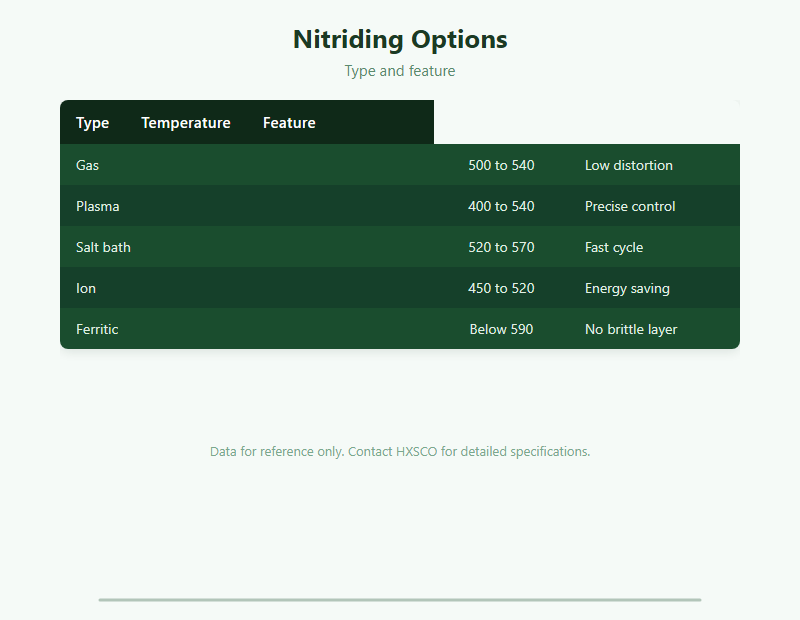
Gas nitriding is the workhorse, plasma gives precise control and salt bath is fast; ferritic variants avoid a brittle layer, with the broader route in our Surface Hardening Supplier page.
Quality and Certification
Case depth and surface hardness are verified; confirm with our Quality Inspection Guide and documents per our Mill Test Certificate Guide.
Get a Quote
Tell HXSCO your requirements and we will respond with a competitive quote and lead time.
Frequently Asked Questions
Nitriding is lower heat, less distortion.
Plasma or gas nitriding.
400 to 570 C.
Yes – with proper grade.
Yes – hardness and depth report.
Get a Nitriding Quote
HXSCO arranges gas, plasma and salt-bath nitriding with case reports. Send part type and material for a quote.