


Short answer: Corrosion monitoring tracks metal loss in service with weight-loss coupons, linear-polarisation resistance and electrochemical impedance probes, electrical-resistance probes and field surveys — turning unknown degradation into a managed rate and remaining life.
At a Glance
Why Monitor Corrosion
You cannot manage what you cannot measure: monitoring converts unknown loss into a rate you can budget against. The maths behind rates is in Metal Corrosion Rate Calculation Guide; the lab methods in Metal Corrosion Testing Guide; the chemistry in Metal Corrosion Inhibitor Guide.
The Toolbox
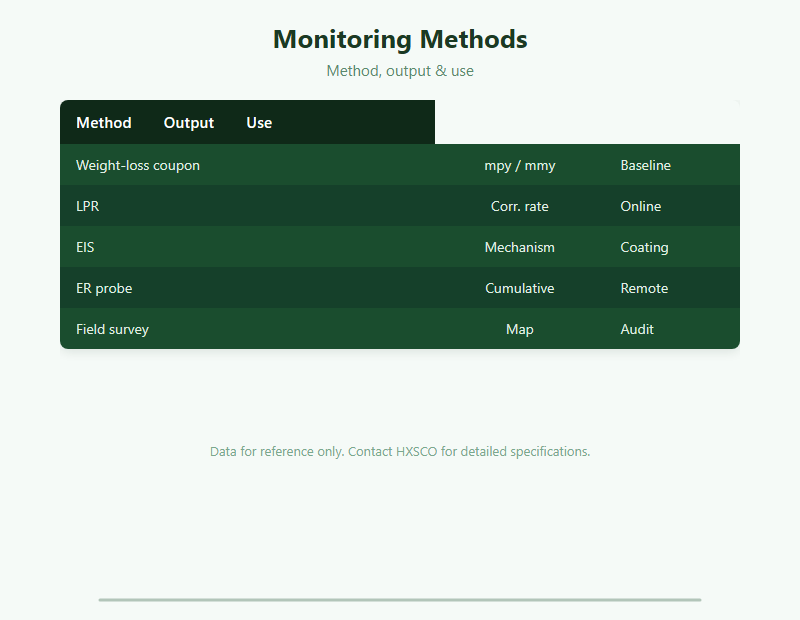
Coupons give an absolute baseline (mpy/mmy); LPR and EIS give online rate and mechanism (coating health); ER probes accumulate loss remotely; field surveys map hot spots. Pair with Metal Ndt Guide and Cathodic Protection Guide; design margin via Metal Corrosion Allowance Guide.
Action & Supply
When the rate climbs, adjust inhibitor, inspect (Metal Failure Analysis Guide) and re-order stock documented per Mill Test Certificate Guide. HXSCO supplies corrosion-selected grades so your monitoring stays in budget.
Get a Quote
Tell HXSCO your requirements and we will respond with a competitive quote and lead time.
Frequently Asked Questions
Measuring metal loss in service to turn unknown degradation into a managed rate and remaining life.
A linear-polarisation-resistance probe that reports corrosion rate online from a small polarisation scan.
Electrochemical impedance spectroscopy reveals the corrosion mechanism and coating barrier health.
They give an absolute, simple baseline rate (mpy/mmy) that validates the electrical methods.
HXSCO supplies grades selected so your monitored corrosion rate stays within budget.
Source Corrosion-Selected Metal from HXSCO
HXSCO supplies corrosion-selected grades so your monitoring stays in budget. Send your service and quantity for a quote.