


Short answer: Brazing joins metals with a molten filler below the base melting point, using silver, copper-zinc or aluminum-silicon fillers applied by torch, furnace or induction; the right filler and joint design make a strong, leak-tight joint with little distortion.
At a Glance
Brazing vs Soldering vs Welding
Brazing sits between soldering and welding in temperature and strength; the welding angle is in our Welding Joining Guide and Stainless Welding Guide, the alloy base in our Nickel Alloy Supplier and the grade families in our Types and Grades of Steel.
Filler Metals
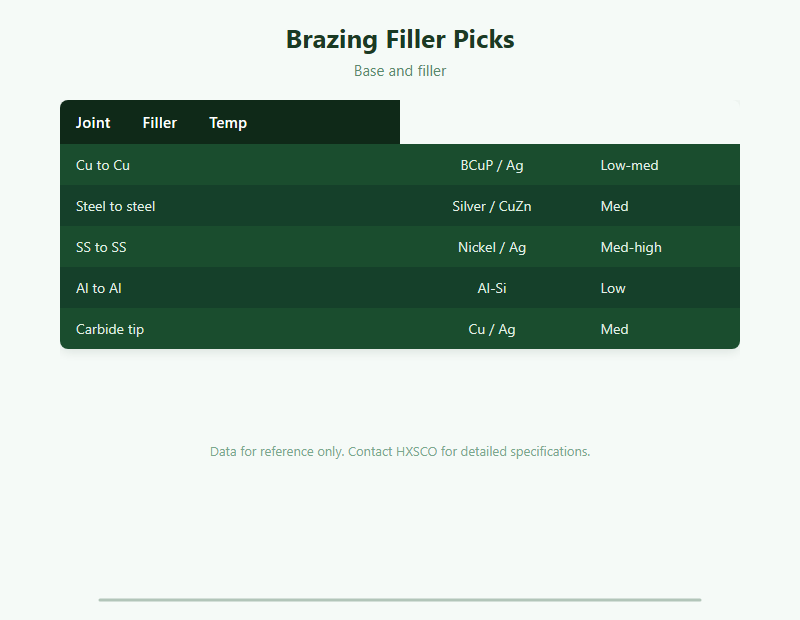
Silver and copper-zinc fill steel, nickel fills stainless, and aluminum-silicon fills aluminum; the stock is in our Copper Supplier, Aluminum Supplier and Stainless Steel Supplier, with corrosion care in our Corrosion Resistance Guide.
Torch, Furnace and Induction
Torch suits repair, furnace suits volume, induction suits precision; the heat treatment that follows is in our Heat Treatment Guide, fatigue limits in our Fatigue Guide and the data in our Strength Comparison.
Joint Design and Care
Clearance and clean surfaces decide the capillary fill; the dimensional limits are in our Tolerances Guide, the proof in our Mill Test Certificate Guide and packing in our Export Packing Guide.
Get a Quote
Tell HXSCO your requirements and we will respond with a competitive quote and lead time.
Frequently Asked Questions
Brazing uses a lower-melt filler and does not melt the base metal.
Nickel or silver brazing filler for stainless joints.
Yes — with aluminum-silicon filler and proper flux or atmosphere.
Yes — brazing works at higher temperature and higher strength.
Less than welding, since the base stays below its melting point.
Join Metal with HXSCO Stock
HXSCO supplies the copper, aluminum, stainless and alloy stock your brazing process needs. Send the joint and we will recommend a grade and quote.