


Short answer: Metal bending forms sheet and plate without cutting — press brakes make most V-bends, roll benders form cylinders and arcs, and rotary-draw bends tube and sections; success depends on bend radius, springback and the metal’s ductility.
At a Glance
How Metal Is Bent
Bending plastically deforms the outer fibre while the inner fibre compresses, so the part springs back slightly after the load leaves. It pairs with Metal Stamping Vs Machining and is fed by our Steel Plate Supplier and Steel Sections Guide programmes; the feedstock contrast is in Cold Rolling Vs Hot Rolling.
Methods & Design Rules
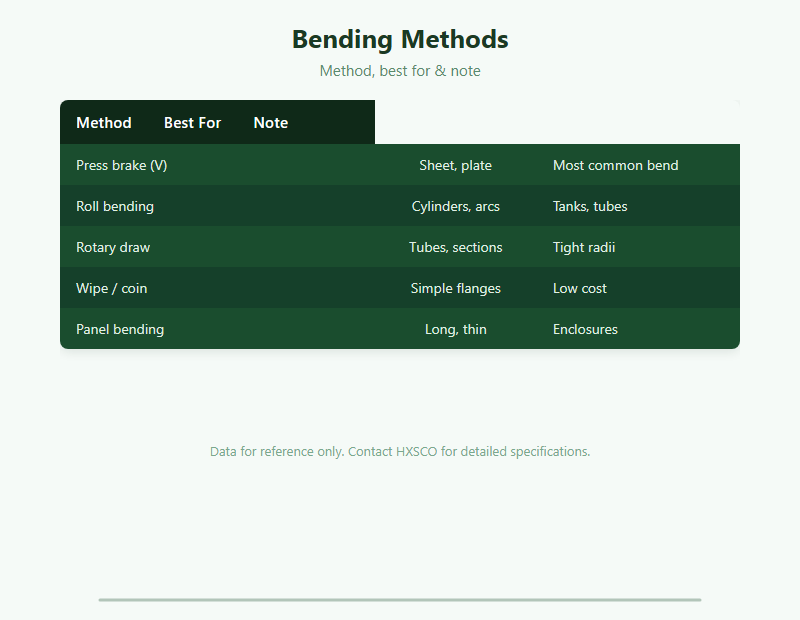
The press brake is the default for V-bends in sheet and plate; roll bending makes cylinders for tanks and ducts; rotary-draw bends tube and sections to tight radii without collapse. Keep the inside radius at least the thickness (≈1.5×t for clean bends), respect the metal’s ductility and allow for springback — which scales with strength, so check Yield Strength Vs Tensile Strength. Aluminium bends easily (see Aluminum Supplier); high-strength steel needs more tonnage.
Applications & Sourcing
Bending builds brackets, enclosures, frames, hoppers, ducts and rolled rings from bar (see Steel Rod Supplier) and plate. We bend to your drawing, deburr and coat; every lot ships with a mill certificate per Mill Test Certificate Guide.
Get a Quote
Tell HXSCO your requirements and we will respond with a competitive quote and lead time.
Frequently Asked Questions
The press brake is the most common method for V-bends in sheet and plate; roll bending forms cylinders and rotary-draw bends tube.
Springback is the slight elastic return of the metal after the bend load is removed; it grows with yield strength and must be over-bent to hold the angle.
As a rule keep the inside radius at least the material thickness (≈1.5×t for a clean bend); tighter radii risk cracking, especially in high-strength or brittle metals.
Yes. HXSCO bends sheet, plate, tube and bar to drawing with deburring and coating, and mill certificates.
Bend Metal with HXSCO
HXSCO bends sheet, plate, tube and bar to your drawing with springback compensation and coating. Send your part and quantity for a quote.