


Short answer: Aluminium extrusion defects — surface lines, tearing, hollow-seam welds, twist and coarse grain — almost always trace to die condition, temperature or quench balance, and are fixed by controlling billet heat, exit speed and uniform cooling.
At a Glance
Where Defects Come From
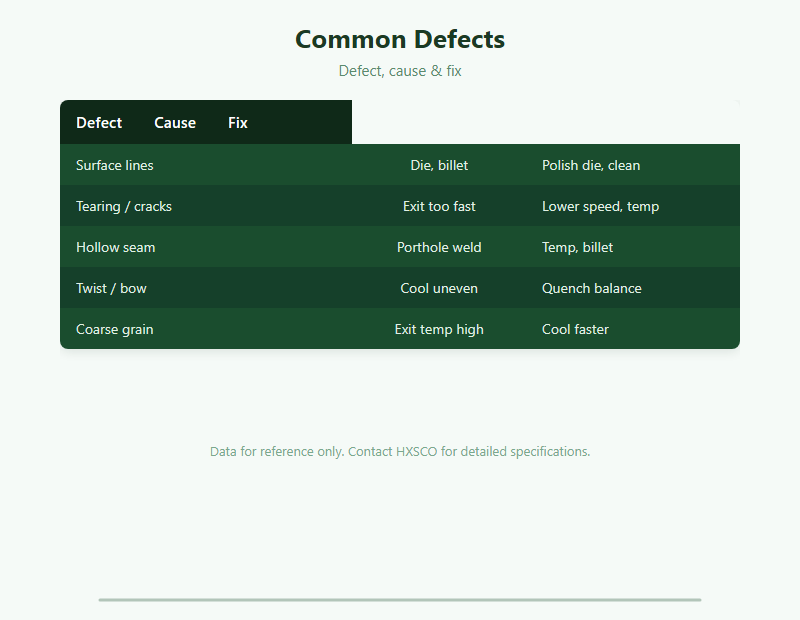
Extrusion pushes heated billet through a die; most defects appear at the die or the exit. Surface lines come from a worn or dirty die and contaminated billet; tearing and edge cracks mean the metal exited faster than it could flow. The process basics are in Aluminum Extrusion Supplier and the design rules in Aluminum Extrusion Design Guide.
Seams, Shape & Grain
Hollow profiles use a porthole die; if temperature or billet quality is off, the two metal streams fail to weld and leave a seam. Twist and bow come from uneven quench, and coarse grain from too-high exit temperature. Finish matters too — a poor anodise reveals defects, so surface prep follows Anodized Aluminum Guide and Metal Surface Treatment Guide.
Preventing & Inspecting
Hold billet temperature and exit speed in range, keep the die polished, balance the quench, and choose the right alloy from Aluminum Alloy Series Guide for the section. We supply extruded stock from our Aluminum Supplier and Aluminum Coil Supplier lines with surface and dimensional checks per Mill Test Certificate Guide.
Get a Quote
Tell HXSCO your requirements and we will respond with a competitive quote and lead time.
Frequently Asked Questions
Worn or dirty die bearings and contaminated billet are the usual cause; polishing the die and cleaning the billet removes them.
Exiting the die faster than the metal can flow causes tearing and edge cracks; lowering exit speed and holding billet temperature fixes it.
In porthole-die hollow profiles, the two metal streams may fail to weld, leaving a seam — caused by low temperature or poor billet quality.
Balance the quench so the profile cools evenly; uneven cooling is the main cause of distortion after exit.
HXSCO supplies extruded profiles with controlled billet temperature, die maintenance and dimensional checks; tell us your alloy and tolerance.
Source Extruded Aluminium from HXSCO
HXSCO supplies aluminium extrusions with controlled temperature, die care and dimensional checks. Send your profile, alloy and tolerance for a quote.