


Short answer: Heat-exchanger material choice balances thermal conductivity, corrosion resistance and cost: titanium and copper-nickel rule seawater duty, stainless suits clean steam, Hastelloy and Incoloy handle acid and high temperature, and carbon steel works only with treated water.
At a Glance
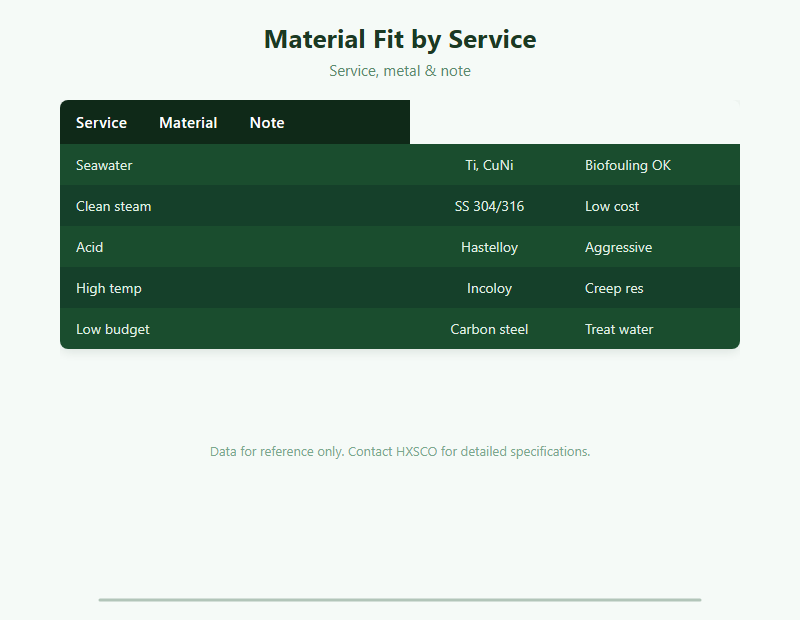
Matching Metal to Duty
Seawater shells and tubes lean on Titanium Supplier und Copper Nickel Supplier; aggressive acid uses Hastelloy Supplier; high-temperature recuperators use Inconel Vs Monel und Nickel Alloy Supplier. Marine fouling ties to Seawater Corrosion Guide und Galvanic Corrosion Guide.
Design Drivers
Conductivity sets tube wall and size (Metal Thermal Conductivity Guide), corrosion margin uses Metal Corrosion Inhibitor Guide, and creep limits high-temperature alloys — see Metal Creep Guide. Avoid Galvanic Corrosion Guide between dissimilar tube and tube-sheet.
QA & Supply
Hydro-test and inspect by Metal Ndt Guide, document per Mill Test Certificate Guide, and protect via How To Prevent Metal Rust. HXSCO supplies tube, plate and sheet for exchanger fabrication.
Get a Quote
Tell HXSCO your requirements and we will respond with a competitive quote and lead time.
Häufig gestellte Fragen
Titanium and 90/10 copper-nickel are the standards for seawater tube and shell.
It resists aggressive acids and chlorides where stainless would fail.
Yes for clean, non-chloride steam and water; not for seawater or acid.
Creep and oxidation resistance — use Incoloy or nickel alloys above ~600°C.
HXSCO supplies titanium, CuNi, stainless, Hastelloy and nickel-alloy tube and plate for exchangers.
Source Heat-Exchanger Metal from HXSCO
HXSCO supplies titanium, CuNi, stainless, Hastelloy and nickel-alloy tube and plate for heat exchangers. Send your service and quantity for a quote.