


Short answer: Corrosion inhibitors slow attack by adsorbing a protective film on the metal surface — anodic types passivate the anode, cathodic types slow the cathode, and vapour-phase (VCI) types protect enclosed parts in transit — so the right class depends on the metal, the environment and how the part is used.
At a Glance
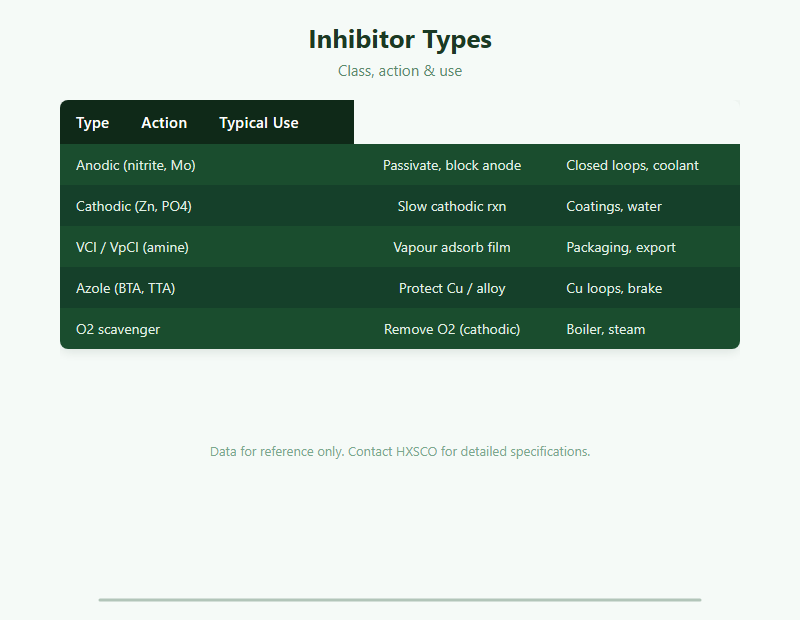
How Inhibitors Protect Metal
Corrosion needs an anodic and a cathodic reaction; an inhibitor interferes with one of them. Anodic inhibitors (nitrite, molybdate) form a passive film on the anode, while cathodic inhibitors (zinc, phosphate) slow the cathodic half-reaction by precipitating a barrier. The underlying electrochemistry is the same mechanism behind Galvanic Corrosion Guide und Pitting Corrosion Stainless Steel.
Anodic vs Cathodic vs VCI
Anodic inhibitors give strong protection but can accelerate attack if under-dosed, so they are used where concentration is controlled (coolant loops). Cathodic inhibitors are safer for open systems and coatings. Vapour-phase corrosion inhibitors (VCI / VpCI, amine-based) sublimate and coat enclosed surfaces — ideal for export packing, pairing with the surface care in How To Prevent Metal Rust. Azoles such as BTA specifically shield copper, relevant to our Copper Supplier und Busbar Copper Vs Aluminum products.
Selecting & Handling
Match the inhibitor to metal and medium: nitrite for steel loops, azole for copper, VCI for stored or shipped parts, oxygen scavenger for boilers. Many are dosed into coatings and oils per Metal Surface Treatment Guide, and all complement a corrosion-resistant grade choice from Edelstahlsorten erklärt oder Cathodic Protection Guide where access is hard.
Get a Quote
Tell HXSCO your requirements and we will respond with a competitive quote and lead time.
Häufig gestellte Fragen
A chemical that adsorbs on the metal surface to block the anodic or cathodic half-reaction of corrosion, slowing the overall attack rate.
Anodic inhibitors passivate the anode (strong but risky if under-dosed); cathodic inhibitors slow the cathode by precipitating a barrier and are safer for open systems.
A vapour-phase corrosion inhibitor that sublimes and coats enclosed metal surfaces — used in packaging, paper and export crates to protect parts in transit and storage.
Azole inhibitors such as benzotriazole (BTA) and tolyltriazole (TTA) specifically passivate copper and its alloys against tarnish and dezincification.
HXSCO supplies corrosion-resistant grades (stainless, galvanised, aluminium) and can advise on inhibitor-compatible finishes; contact us with your duty and packaging need.
Source Corrosion-Resistant Metal from HXSCO
HXSCO supplies stainless, galvanised and aluminium grades and can advise on inhibitor-compatible finishes for storage and export. Send your duty and quantity for a quote.