


Short answer: Permanent mold casting pours molten metal by gravity into a reusable steel (or iron) mould, delivering denser, more dimensionally accurate parts than sand casting and higher volumes than one-off moulds — but below the throughput of high-pressure die casting. It suits aluminium, magnesium, zinc and copper alloys for automotive, hardware and machinery components where a semi-permanent tool pays back across thousands of parts.
At a Glance
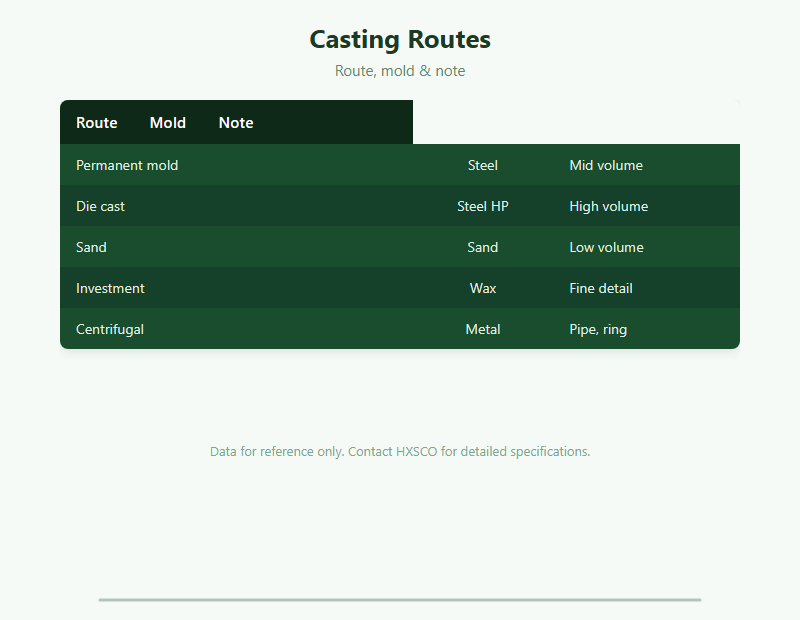
Permanent Mold vs Others
Compare Metal Die Casting Guide e Metal Sand Casting Guide; relate to Investment Casting Vs Die Casting e Metal Grain Size Guide.
Qualidade
Density and porosity checked by Metal Ndt Guide, documented per Mill Test Certificate Guide. Relate to Metal Machinability Guide.
Supply & QA
Finish via Metal Surface Treatment Guide and protect via How To Prevent Metal Rust. HXSCO supplies mouldable alloys to spec.
Get a Quote
Tell HXSCO your requirements and we will respond with a competitive quote and lead time.
Perguntas frequentes
Gravity pouring into a reusable steel mould.
PM is gravity, lower volume; die cast is high-pressure, high volume.
Aluminium, magnesium, zinc and copper alloys.
Denser, more accurate, longer tool life.
HXSCO supplies aluminium and copper alloys for PM casting.
Source Permanent-Mold Alloys from HXSCO
HXSCO supplies aluminium, magnesium and copper alloys suited to permanent-mold casting. Send your alloy and quantity for a quote.