


Short answer: Plasma (ion) nitriding hardens a steel surface in a low-pressure glow discharge: ionized nitrogen bombards the part, diffuses in and forms a hard, low-friction nitride case without the white-layer and distortion of salt or gas nitriding. Running below the tempering temperature of the core, it needs no quenching, so precision parts keep their size while gaining wear and fatigue resistance — widely used on dies, screws, valves and transmission components.
At a Glance
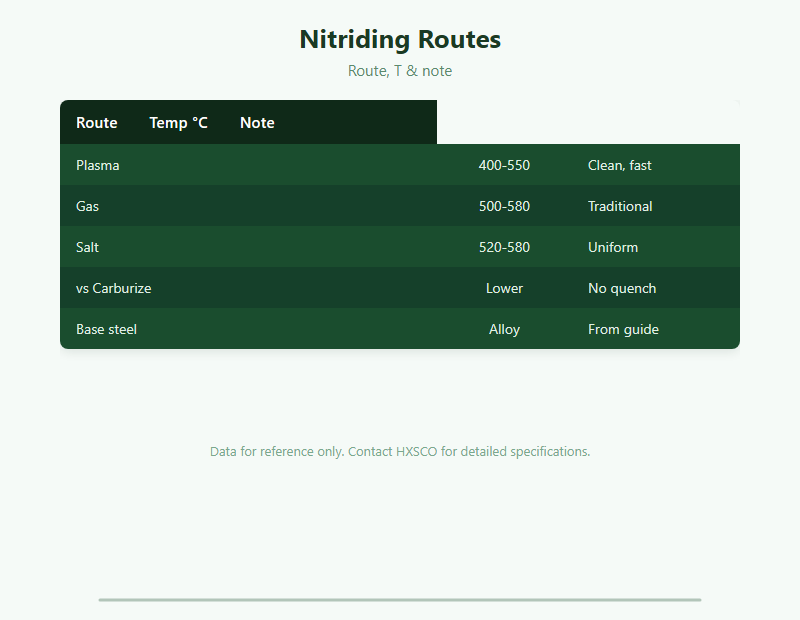
Nitriding Routes
Compare Nitriding Vs Carburizing e Metal Case Hardening Guide; relate to Metal Martensite Guide e Metal Induction Hardening Guide.
Qualidade
Case depth and hardness checked by Metal Hardness Testing Methods, certified by Mill Test Certificate Guide. Compare Metal Flame Hardening Guide.
Supply & QA
Apply after Metal Creep Guide-relevant service; protect via How To Prevent Metal Rust. HXSCO supplies nitriding-grade steel.
Get a Quote
Tell HXSCO your requirements and we will respond with a competitive quote and lead time.
Perguntas frequentes
Glow-discharge nitriding at 400-550 °C, no quench needed.
Plasma is cleaner, faster, less distortion, controllable.
Alloy and nitriding grades (e.g. 4140, 4340, Nitralloy).
Minimal — it runs below the core tempering temperature.
HXSCO supplies alloy steel suited to plasma nitriding.
Source Nitriding-Grade Steel from HXSCO
HXSCO supplies alloy and nitriding-grade steel bar and plate for plasma nitriding. Send your grade for a quote.