


Short answer: Non-destructive testing (NDT) inspects metal without damaging it — ultrasonic, radiographic, magnetic-particle, penetrant and visual methods find internal and surface flaws in welds, castings and forgings so defective parts are rejected before they ever enter service.
At a Glance
What NDT Is
NDT proves a part is sound without cutting it open. It complements the certificate in Mill Test Certificate Guide and the routes that create the part — our Casting Supplier e Forging Supplier programmes both rely on it for soundness. Where destructive proof (tensile, impact) samples one part, NDT checks every part.
The Five Core Methods
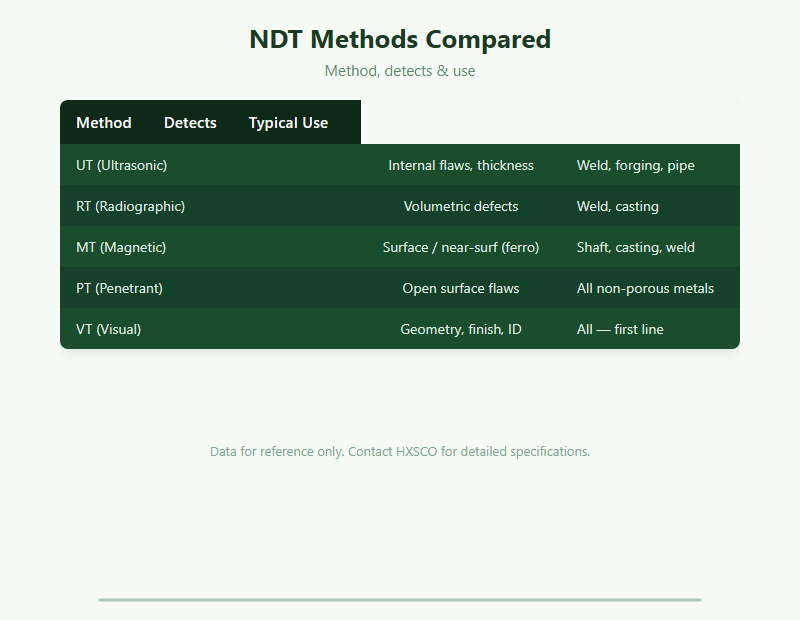
Ultrasonic (UT) sends sound waves to find internal flaws and measure wall thickness — the workhorse for welds, forgings and pipe. Radiographic (RT) uses X/gamma rays for a volumetric view of castings and welds. Magnetic-particle (MT) reveals surface and just-below-surface cracks in ferromagnetic steel. Penetrant (PT) dyes surface-breaking flaws on any non-porous metal. Visual (VT) is the cheap first line for geometry, finish and identification. Hardness and impact testing relate in Metal Hardness Testing Methods e Charpy Impact Test Guide.
Specifying & Quality
Choose the method by the defect you fear and the metal (MT only on ferromagnetic steel). Levels follow ISO 9712 / ASNT; acceptance follows the drawing or code. NDT results are recorded alongside the mill certificate, and corrosion-prone parts are then coated per Metal Surface Treatment Guide.
Get a Quote
Tell HXSCO your requirements and we will respond with a competitive quote and lead time.
Perguntas frequentes
Non-destructive testing inspects metal without damaging it — ultrasonic, radiographic, magnetic-particle, penetrant and visual methods find internal and surface flaws before service.
Ultrasonic (UT) and radiographic (RT) are the main volumetric weld tests; magnetic-particle (MT) and penetrant (PT) catch surface cracks. The choice follows the code and the flaw type.
UT, RT, PT and VT work on all metals; magnetic-particle (MT) only works on ferromagnetic steel. Penetrant works on any non-porous surface.
Yes. HXSCO supplies cast, forged and welded components with NDT (UT/MT/PT) and mill certificates on request.
Source NDT-Inspected Metal from HXSCO
HXSCO supplies cast, forged and welded metal with UT/MT/PT inspection and mill certificates. Send your part, code and quantity for a quote.