


Short answer: Permanent mold casting pours molten metal by gravity into a reusable steel (or iron) mould, delivering denser, more dimensionally accurate parts than sand casting and higher volumes than one-off moulds — but below the throughput of high-pressure die casting. It suits aluminium, magnesium, zinc and copper alloys for automotive, hardware and machinery components where a semi-permanent tool pays back across thousands of parts.
At a Glance
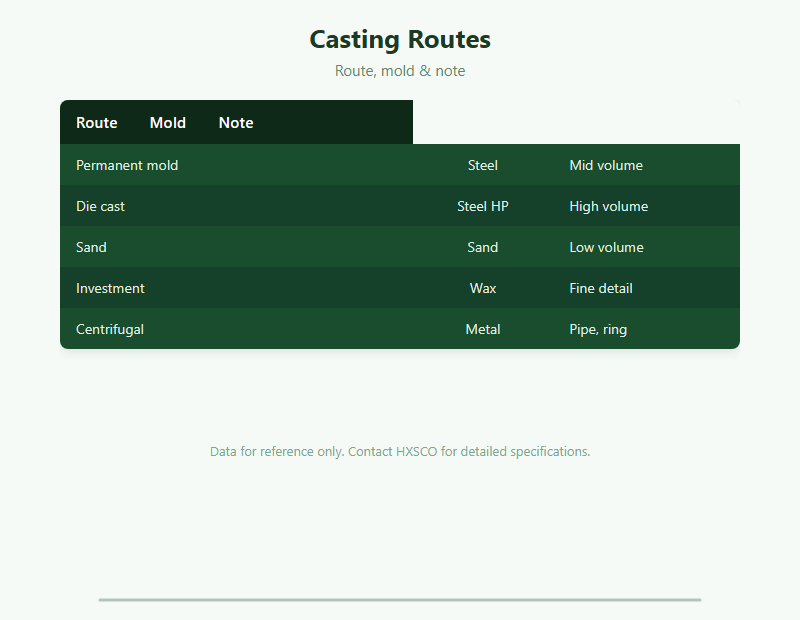
Permanent Mold vs Others
Compare Metal Die Casting Guide en Metal Sand Casting Guide; relate to Investment Casting Vs Die Casting en Metal Grain Size Guide.
Kwaliteit
Density and porosity checked by Metal Ndt Guide, documented per Mill Test Certificate Guide. Relate to Metal Machinability Guide.
Supply & QA
Finish via Metal Surface Treatment Guide and protect via How To Prevent Metal Rust. HXSCO supplies mouldable alloys to spec.
Get a Quote
Tell HXSCO your requirements and we will respond with a competitive quote and lead time.
Veelgestelde vragen
Gravity pouring into a reusable steel mould.
PM is gravity, lower volume; die cast is high-pressure, high volume.
Aluminium, magnesium, zinc and copper alloys.
Denser, more accurate, longer tool life.
HXSCO supplies aluminium and copper alloys for PM casting.
Source Permanent-Mold Alloys from HXSCO
HXSCO supplies aluminium, magnesium and copper alloys suited to permanent-mold casting. Send your alloy and quantity for a quote.