


Short answer: Pitting is localised attack that punches deep, narrow holes where the passive film breaks down in chlorides; resist it with higher chromium, molybdenum and nitrogen (higher PREN) — 316, duplex 2205, super-austenitic and nickel alloys — plus clean surfaces and lower chloride and temperature.
At a Glance
How a Pit Forms
A breakdown in the passive film — often at inclusions, scratches or deposits — lets chlorides attack locally while the surrounding metal stays protected. The mechanism is compared with general and crevice attack in our Galvanic Guide. Material basics are in our Stainless Supplier.
Reading PREN
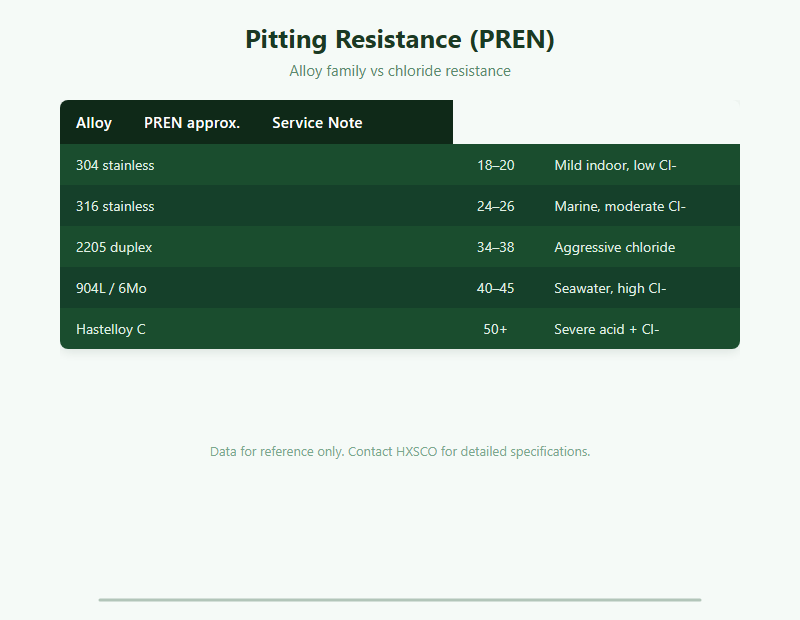
Pitting Resistance Equivalent Number (PREN = %Cr + 3.3×%Mo + 16×%N) ranks alloys; 316 sits around 25, duplex 2205 near 36, and super-austenitics above 40. Grade selection is in our Steel Grade Chart en Galvanized Supplier for coated alternatives.
What Makes It Worse
Warm chlorides, stagnant solution, deposits and rough surfaces accelerate pitting. Finish and roughness are controlled per Surface Roughness Ra Guide; passivation rebuilds film in our Passivation Guide; coating as back-up in our Powder Coating Guide.
Specifying for Chloride Service
For marine and process chlorides choose 316 minimum, duplex 2205 for aggressive duty, and 6Mo or nickel alloys for seawater. Confirm chemistry and test with a mill cert from our Mill Test Certificate Guide; weld quality per our Welded Tube Guide.
Get a Quote
Tell HXSCO your requirements and we will respond with a competitive quote and lead time.
Veelgestelde vragen
Pitting Resistance Equivalent Number — higher means better chloride resistance.
No — 304 pits quickly; use 316 or duplex in chloride.
Duplex 2205 or super-austenitic 6Mo for aggressive seawater.
Yes — smoother surfaces pit less; finish per Ra guide.
Coatings and passivation help, but alloy choice is primary.
Specify Pitting-Resistant Alloys from HXSCO
HXSCO supplies 316, duplex 2205, 904L and nickel alloys with PREN-confirmed mill certs for chloride service. Send your environment for a quote.