


Short answer: Radiographic testing projects X-rays or gamma rays through a part onto film or a digital detector to reveal internal porosity, cracks and inclusions; X-ray gives sharper images on thinner sections, while portable gamma sources (Ir-192, Co-60) handle thick, field welds — both need strict radiation safety and are slower than UT.
At a Glance
How RT Images Flaws
Density differences from voids, slag or lack of fusion attenuate the beam and show as shadows on the radiograph. RT is the volumetric counterpart to Ultrasonic Testing en Penetrant Testing. Acceptance criteria are on our Mill Test Certificate Guide.
X-ray vs Gamma
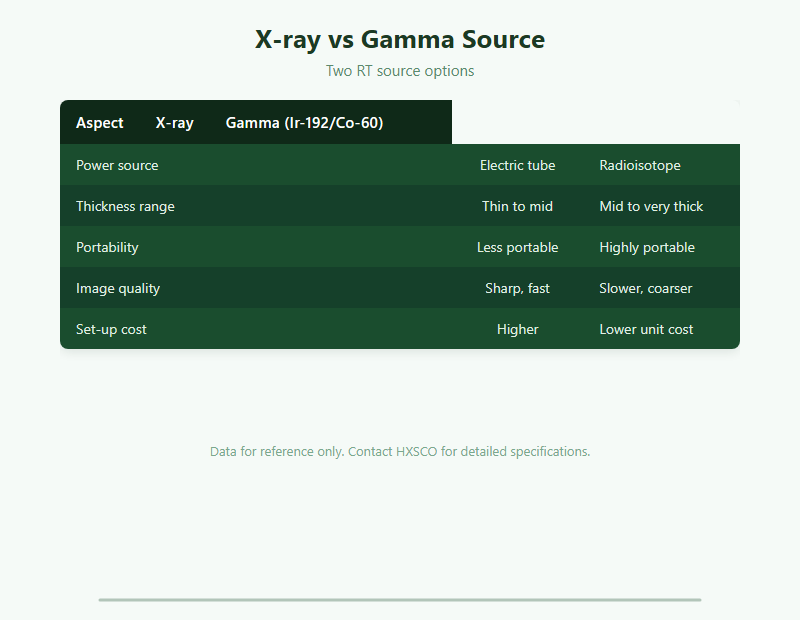
X-ray tubes produce sharper, faster images on thinner and mid-thickness parts but need power; gamma isotopes are compact and reach very thick sections in the field but are slower with coarser images. Geometry and wall reference in our Tolerances Fits Guide.
Where RT Is Specified
Pressure equipment, pipelines and structural welds often mandate RT for a permanent record. It is standard on our Steel Pipe Supplier en Pipe Fittings Supplier critical welds; heat zones in our Heat Treatment Guide.
Limits and Safety
RT needs radiation shielding, exclusion zones and certified operators, and is slower and costlier than UT for many jobs. Surface finish still matters per Surface Roughness Ra Guide; for surface-only checks PT is cheaper.
Get a Quote
Tell HXSCO your requirements and we will respond with a competitive quote and lead time.
Veelgestelde vragen
RT gives a permanent record; UT is faster and portable.
Ir-192 for mid thickness, Co-60 for very thick steel.
It needs shielding and certified operators — strict safety.
Poorly — PT/MT are better for surface flaws.
Equipment, shielding, operator cert and slower exposure.
Supply RT-Inspected Metal from HXSCO
HXSCO supplies pipes, fittings and welds with RT and mill certificates to code. Send your radiographic acceptance level for a quote.