


Short answer: Glass plants use nickel alloys and stainless for high-temperature lehr rollers and baffles, cast iron and steel for stable moulds, and stainless and structural steel for frames and conveyors, chosen for heat resistance, dimensional stability and clean, non-staining contact with hot glass.
At a Glance
Heat and Stability
Hot glass needs metals that stay flat and clean, with the basis in our Creep and High-Temperature Guide y Nickel Alloy Grades Guide; thermal movement is in our Thermal Expansion Guide.
Rollers and Moulds
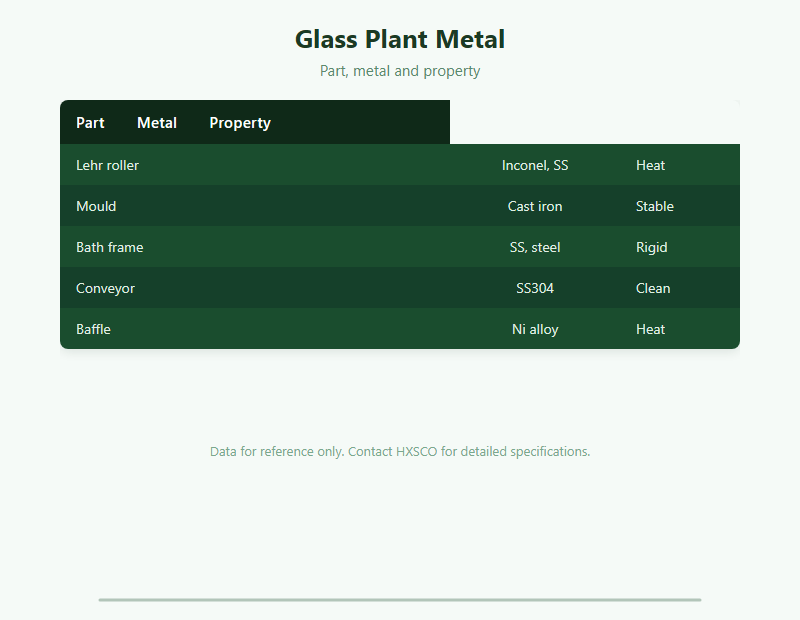
Lehr rollers use nickel alloy and stainless, while moulds use cast iron for stability, with casting in our Casting Methods Guide and finish in our Surface Treatment Guide.
Frames and Lines
Stainless and structural steel build the bath and conveyor, detailed in our Structural Guide y Sheet Fabrication Guide; welding in our Welding Joining Guide.
Sourcing and Care
Buyers match grade to furnace zone and confirm cert via our Mill Test Certificate Guide; packing is in our Export Packing Guide.
Get a Quote
Tell HXSCO your requirements and we will respond with a competitive quote and lead time.
Preguntas frecuentes
Nickel alloy and stainless resist the annealing heat without warping.
Cast iron holds a stable, fine surface for forming hot glass.
Stainless and structural steel give rigid, clean support.
High-temperature creep can warp; nickel alloys and cooling control it.
Mill certificate and PMI confirm the alloy for each furnace zone.
Source Glass Plant Metal with HXSCO
HXSCO supplies nickel alloy, stainless, cast iron and structural steel for glass furnace rollers, moulds and frames. Send your zone conditions for a quote.