


Short answer: Good die casting mold design balances parting line, gating, venting, cooling, draft and ejection to fill the cavity cleanly, control temperature and eject parts reliably; the process context is in our Die Casting Guide.
At a Glance
Parting Line and Die Layout
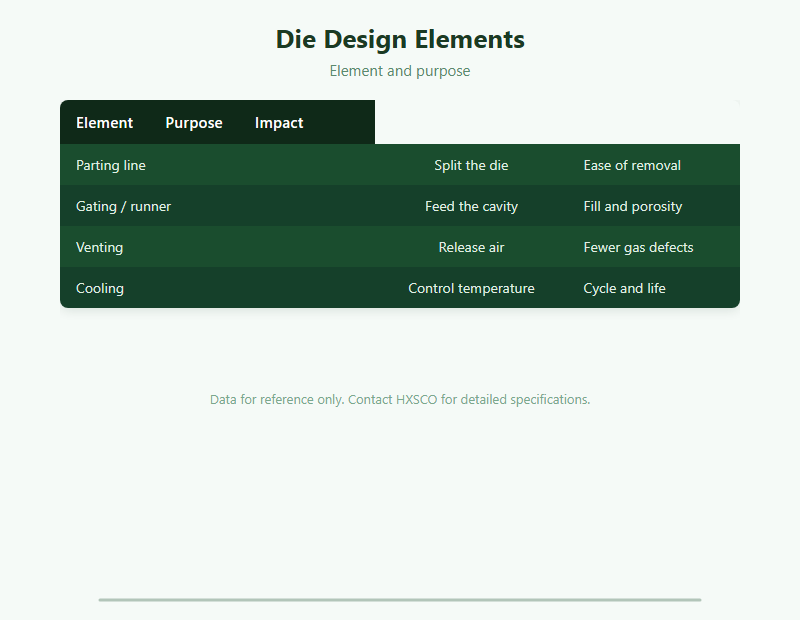
The parting line sets how the die opens and where flash forms; a good layout eases ejection and finishing; the process basis is in our Die Casting Guide.
Gating and Runner Systems
Gate size and position control fill pattern and porosity; poor gating causes cold shuts and turbulence, covered in our Defects Guide.
Venting and Vacuum Assist
Vents let trapped air escape; vacuum systems further reduce gas porosity and support heat treatable castings.
Cooling Channels and Temperature
Conformal cooling holds die temperature, cutting cycle time and thermal fatigue; the thermal context is in our Heat Treatment Guide.
Draft Angles and Ejection
Adequate draft and a balanced ejector system prevent sticking and distortion; wall thickness and thin-wall limits are in our Aluminum Die Casting Supplier page.
Design for Manufacture
Early design review reduces tooling revisions; supplier selection is in our Choose a Supplier Guide and volume planning in our MOQ and Lead Time Guide.
Get a Quote
Tell HXSCO your requirements and we will respond with a competitive quote and lead time.
Preguntas frecuentes
It sets die opening, flash location and ejection.
It releases trapped air to reduce porosity.
For stable fill, shorter cycles and longer tool life.
Taper that lets the part release from the die.
Yes – see our die casting supplier page.
Get Tooling Support
HXSCO supports die design and manufactures die castings with inspection certificates. Send your part drawing for a tooling and part quote.