


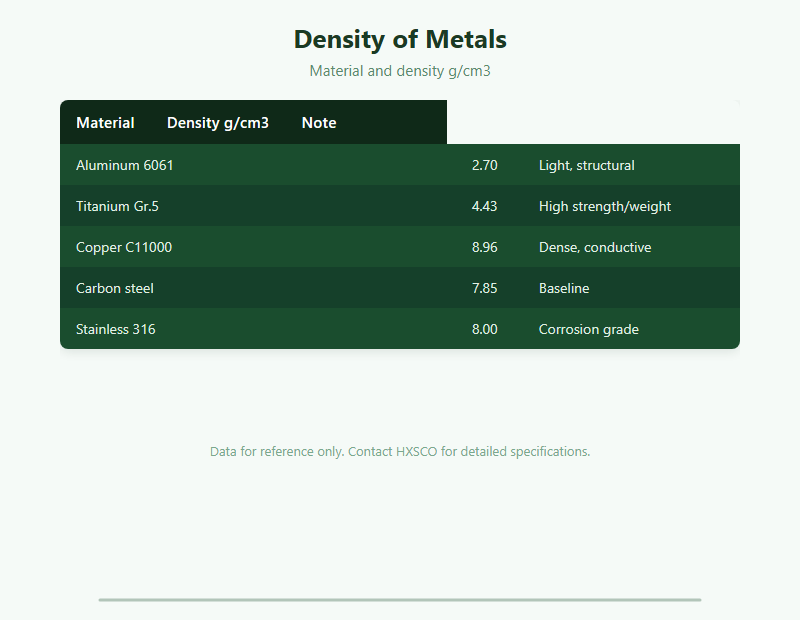
Short answer: Density sets how much a part weighs per volume: aluminum is light at about 2.70 g/cm3, titanium about 4.43, carbon steel about 7.85, stainless about 8.00 and copper about 8.96, so designers trade weight against strength, corrosion and conductivity when choosing a grade.
At a Glance
Why Density Matters
Weight drives shipping, handling and performance; the strength per weight is in our Comparación de fuerzas, the alloy base in our ¿Qué es la aleación de aluminio? and the data in our Types and Grades of Steel.
Light Metals
Aluminum and titanium give high strength per kilo; the stock is in our Aluminum Supplier y Titanium Supplier, profiles in our Extrusion Profiles Guide and the finish in our Anodized Aluminum Guide.
Dense Conductors
Copper is heavy but conducts best; the conductor angle is in our Busbar Copper vs Aluminium guide and the stock in our Copper Supplier y Copper Bar Rod.
Design and Weight
Mass is density times volume, checked against tolerances in our Tolerances Guide, corrosion in our Corrosion Resistance Guide and packing in our Export Packing Guide.
Get a Quote
Tell HXSCO your requirements and we will respond with a competitive quote and lead time.
Preguntas frecuentes
Aluminum, about 2.70 g/cm3, with good strength per weight.
Its strength-to-weight ratio beats steel in critical parts.
It is dense but its conductivity often outweighs the weight.
Multiply density by volume, then check against the drawing.
Heavier metals cost more per part by mass and shipping.
Choose Weight-Wise Metal with HXSCO
HXSCO supplies aluminum, titanium, copper, steel and stainless in the grade that meets your weight and strength target. Send the requirement and we will quote.