


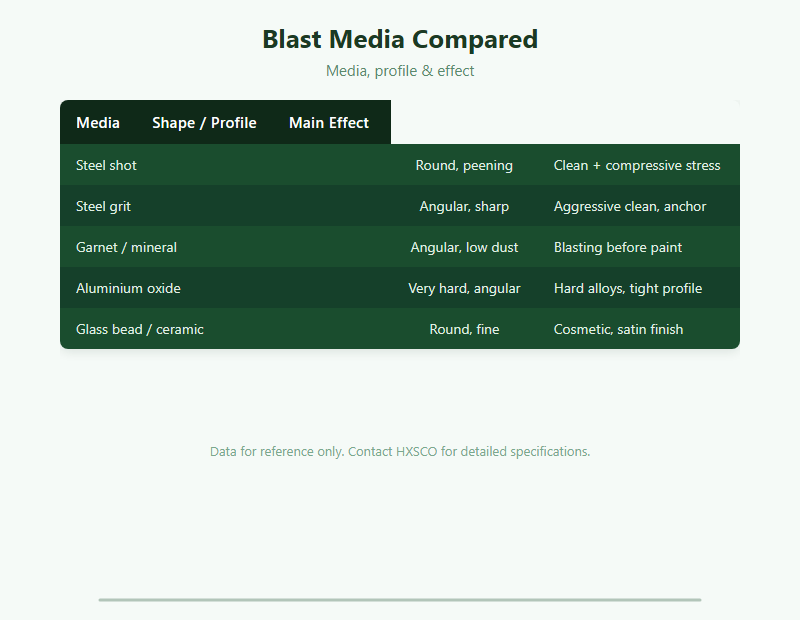
Short answer: Shot blasting fires round steel media that cleans while peening a compressive layer into the surface, whereas sandblasting (now normally garnet or aluminium oxide, not silica sand) fires angular media that cuts an aggressive anchor profile for coating — pick shot for fatigue life and descaling, angular grit for paint adhesion.
At a Glance
Two Different Jobs
Both processes accelerate media at a surface, but the media shape decides the outcome. Round shot deforms the surface plastically, removing scale while leaving a smooth, dimpled finish and a beneficial compressive residual stress — the same mechanism used deliberately in shot peening to extend fatigue life, which matters for the components discussed in Metal Fatigue Endurance Limit. Angular grit cuts and fractures the surface, producing a sharp, high-profile anchor pattern that coatings key into. Both sit upstream of the finishing routes in Metal Surface Treatment Guide.
Media Selection & Silica Warning
Genuine silica sand is prohibited or heavily restricted in most jurisdictions because respirable crystalline silica causes silicosis; modern "sandblasting" uses garnet, aluminium oxide, staurolite or slag. Steel shot and grit are recycled dozens of times in an enclosed wheel-blast machine, which is why plate mills use them for descaling our Steel Plate Supplier y Steel Coil Supplier product. Glass bead and ceramic give a satin cosmetic finish on Stainless Steel Supplier parts without embedding iron — never blast stainless with steel media unless the part will be passivated afterwards per Passivation Vs Pickling.
Specifying Blast Cleanliness
Order by cleanliness grade and roughness, not by media: ISO 8501-1 Sa 2½ (or SSPC-SP 10 near-white) with a 40–75 µm profile is the normal spec ahead of industrial paint or Thermal Spray Coating Guide deposition. Blast then coat within four hours to avoid flash rust, and hold humidity below 85% — background in How To Prevent Metal Rust. Thin sheet can distort under heavy blasting, so use finer media or chemical pickling; for galvanizing, sweep-blasting only, per Hot Dip Galvanizing Process. Blasted parts machined by our Cnc Machining Supplier team are masked on critical surfaces.
Get a Quote
Tell HXSCO your requirements and we will respond with a competitive quote and lead time.
Preguntas frecuentes
Shot blasting uses round steel media that cleans and peens a compressive layer into the surface; sandblasting uses angular mineral media that cuts a sharp anchor profile for coating adhesion.
Blasting with silica sand is banned or heavily restricted in most countries because of silicosis risk. Modern equivalents use garnet, aluminium oxide, staurolite or slag media.
Industrial coatings typically require ISO 8501-1 Sa 2½ (SSPC-SP 10) cleanliness with a 40–75 µm angular profile, coated within four hours of blasting.
Yes, but only with stainless shot, glass bead or ceramic media. Carbon steel media embeds iron particles that later rust, so passivation is required afterwards.
Blast-Cleaned Steel from HXSCO
HXSCO supplies plate, coil and fabricated parts shot-blasted or grit-blasted to ISO 8501-1 Sa 2½ with primer applied. Send your grade, size and coating spec for a quote.