


Short answer: Metal fatigue is crack growth under repeated loading below the yield strength; it is controlled by reducing stress concentration, improving surface finish, choosing the right alloy and heat treatment, and inspecting with NDT so cracks are found before they grow to failure.
At a Glance
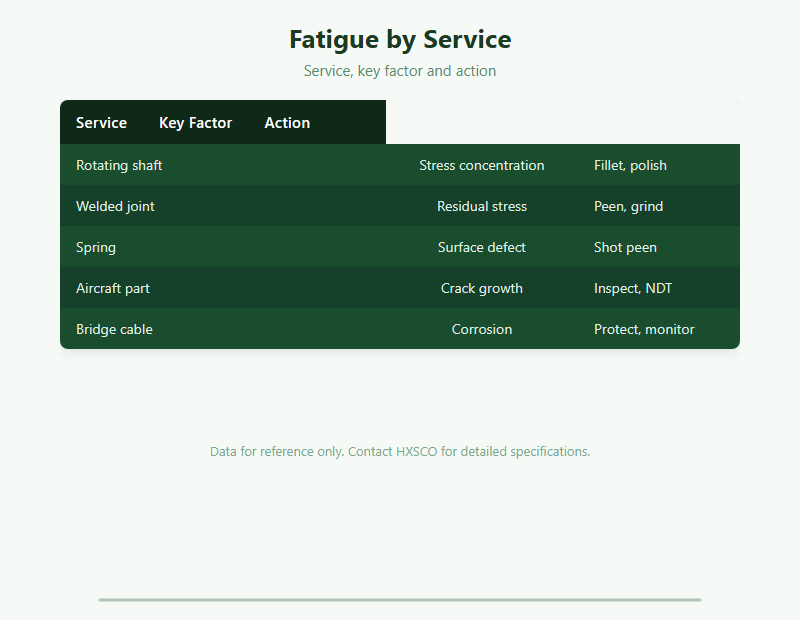
What Fatigue Does
Fatigue starts at a surface or notch and grows each cycle until the part breaks, often below yield; the strength basis is in our Comparación de fuerzas and the choice of alloy in our Aerospace Guide.
Testing and S-N Curves
Rotating-beam and axial tests build S-N curves that show cycles to failure at a stress, with hardness and treatment in our Hardness Comparison y Heat Treatment Guide; quality checks are in our Quality Inspection Guide.
Design and Finish
Generous radii, polished surfaces and shot peening raise fatigue life, with surface detail in our Surface Treatment Guide and fabrication in our Machining Guide; welding joints are covered in our Welding Joining Guide.
Inspection and Sourcing
NDT such as dye penetrant and ultrasonic finds cracks before failure, with methods in our Quality Inspection Guide; buyers confirm grade and cert via our Mill Test Certificate Guide and pack per our Export Packing Guide.
Get a Quote
Tell HXSCO your requirements and we will respond with a competitive quote and lead time.
Preguntas frecuentes
Repeated stress below yield grows a small crack until the part suddenly fails.
Yes – fatigue failure occurs well below the static yield strength over many cycles.
Rotating-beam or axial tests build S-N curves of stress versus cycles to failure.
Reduce stress concentration, improve surface finish, shot peen and inspect with NDT.
High-strength alloys with polished surfaces and compressive residual stress resist best.
Specify Fatigue-Resistant Metal with HXSCO
HXSCO supplies high-strength alloys, heat-treated bar and finished parts with the certificate and NDT your fatigue-critical design needs. Send your spec for a quote.