


Short answer: Cathodic protection stops corrosion by making the protected metal the cathode of an electrochemical cell — either with a more-active sacrificial anode (zinc, aluminium, magnesium) or with an impressed direct current; it is the standard defence for buried pipelines, ship hulls, tanks and offshore structures.
At a Glance
The Principle
Corrosion is an electrochemical cell; cathodic protection supplies electrons so the structure can never act as the anode that dissolves. It is the engineered big brother of the Galvanic Corrosion Guide problem — instead of fighting dissimilar metals, you deliberately attach a sacrificial anode or push current in. It pairs with coatings (see How To Prevent Metal Rust y Hot Dip Galvanizing Process) because CP only has to protect the coating holidays, not the whole area.
Sacrificial vs Impressed Current
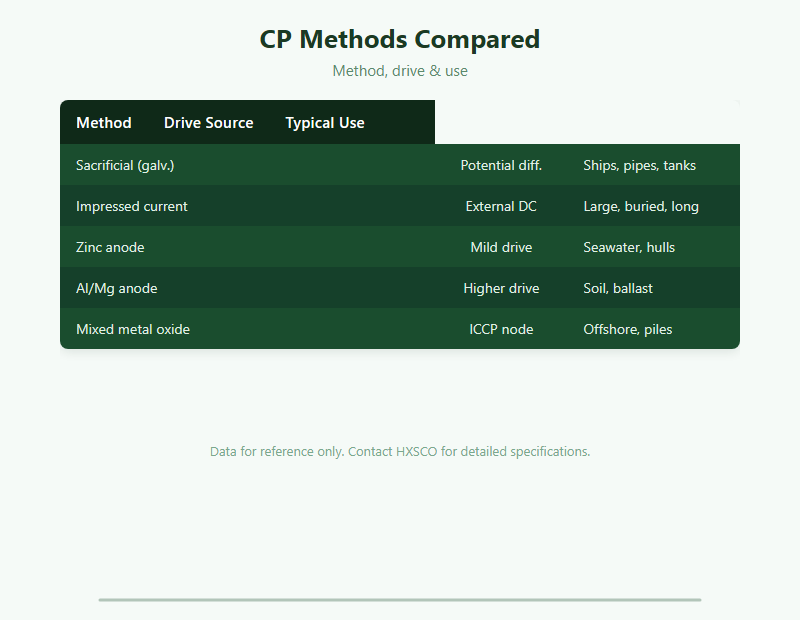
Sacrificial anode (galvanic) CP uses a more-active metal — zinc in seawater, aluminium or magnesium in soil — that corrodes instead of the structure. It needs no power, is simple and self-regulating, but has limited driving force. Impressed current CP (ICCP) uses a rectifier and inert anodes (mixed-metal-oxide, graphite) to push a controlled current, suited to large, high-resistivity or long structures such as cross-country pipelines and platforms. The choice follows size, electrolyte and required life.
Where It Is Used & Verified
CP protects ship hulls and rudders, ballast and cargo tanks, buried and submerged pipelines, storage-tank bottoms, sheet-pile walls and offshore jackets. It is designed and verified by potential surveys against the metal’s corrosion behaviour (see Metal Magnetism Guide for material context) and documented alongside the coating spec. HXSCO supplies the zinc, aluminium and steel substrates and can advise on anode selection for your duty.
Get a Quote
Tell HXSCO your requirements and we will respond with a competitive quote and lead time.
Preguntas frecuentes
Cathodic protection prevents corrosion by making the structure the cathode of an electrochemical cell, either with a sacrificial anode or an impressed current, so the metal no longer dissolves.
Sacrificial CP uses a more-active metal anode (zinc/aluminium/magnesium) with no power; impressed-current CP uses an external DC source and inert anodes for larger or higher-resistance structures.
Zinc anodes are standard for seawater and ship hulls; aluminium anodes give more capacity and are common on offshore structures.
Yes. HXSCO supplies the zinc, aluminium and steel substrates used in cathodic-protection systems and advises on anode selection.
Protect Metal with HXSCO
HXSCO supplies zinc, aluminium and steel substrates for cathodic-protection systems and advises on anode selection. Send your structure and environment for a quote.