


Short answer: Metal failure analysis identifies why a part broke by reading fracture features, microstructure and service conditions; the five classic modes — ductile overload, brittle, fatigue, creep and corrosion — each leave distinct clues that point to the right design or material fix.
At a Glance
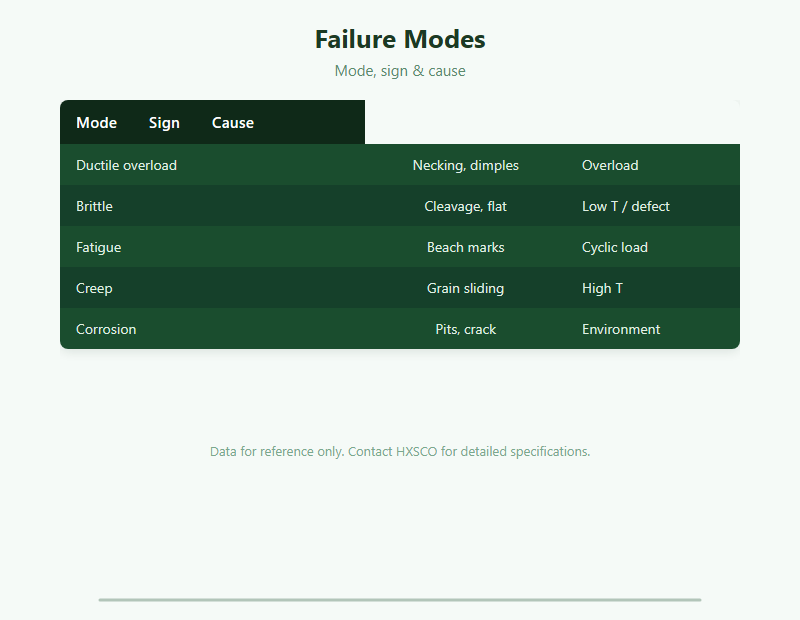
Approach to a Failure
Start from the fracture surface and service history: necking and dimples mean ductile overload, flat cleavage means Metal Brittle Fracture Guide, beach marks mean Metal Fatigue Endurance Limit, and a branching crack with corrosion points to Stress Corrosion Cracking. Toughness context comes from Charpy Impact Test Guide und Tensile Test Guide.
Investigation Tools
Macro and micro examination, hardness mapping (Metal Hardness Testing Methods), Metal Ndt Guide, chemistry and Grain Structure Metals review, plus Metal Identification Guide to confirm the grade. Document everything and compare to the callout per Mill Test Certificate Guide.
Turning Findings into Fixes
Up-rate the material, reduce stress concentrations, add Cathodic Protection Guide or inhibitors via Metal Corrosion Inhibitor Guide, or change the environment and maintenance per How To Prevent Metal Rust. Strength margins are set by Yield Strength Vs Tensile Strength.
Get a Quote
Tell HXSCO your requirements and we will respond with a competitive quote and lead time.
Häufig gestellte Fragen
Ductile overload, brittle fracture, fatigue, creep and corrosion-assisted failure — each with a characteristic fracture appearance.
Fatigue shows beach (clam-shell) marks and a small origin zone from cyclic load; overload shows necking and dimples from a single overstress event.
Fractography (macro/micro), hardness and tensile testing, NDT, chemistry and microstructure review, and grade confirmation.
Low temperature, high constraint, a sharp defect or high strain rate can force a normally ductile metal to fail by cleavage.
HXSCO supplies metal with mill certificates and inspection records to support failure analysis and root-cause work.
Source Traceable Metal from HXSCO
HXSCO supplies metal with full mill certificates and inspection records to support failure analysis and QA. Send your grade, standard and quantity for a quote.