


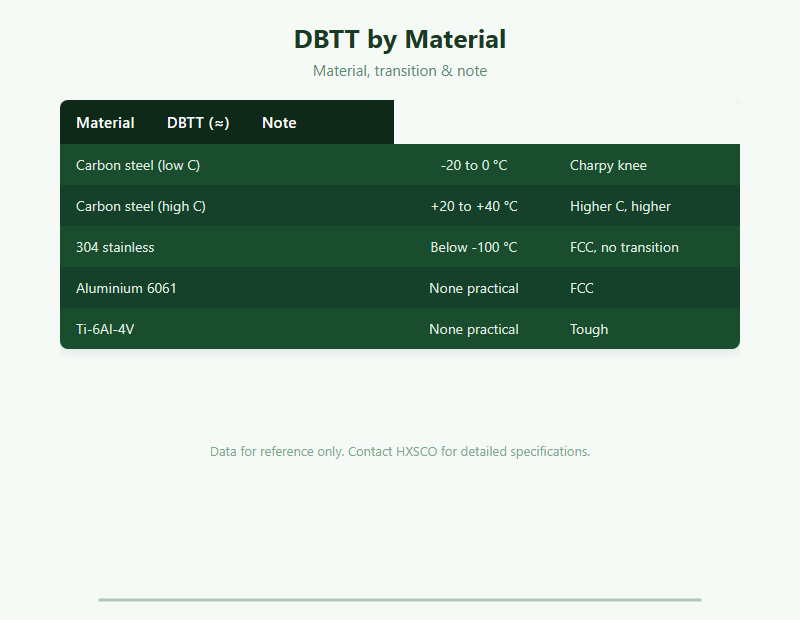
Short answer: Brittle fracture is a sudden, low-energy crack with no warning — it happens when a metal drops below its ductile–brittle transition temperature, where Charpy impact energy plunges. Carbon steels are most at risk near 0 °C, while austenitic stainless, aluminium and titanium stay tough well below freezing.
At a Glance
Why Metal Turns Brittle
Below the ductile–brittle transition temperature (DBTT) a metal loses its ability to deform, so a sharp flaw propagates as a fast cleavage crack instead of blunting. The DBTT is measured by the Charpy Impact Test Guide knee, and the crack can start at a fabrication defect or a fatigue origin covered in Metal Fatigue Endurance Limit.
Materials & Transition Temperature
Plain carbon steel transitions near 0 °C and higher carbon pushes it warmer; fine grain and nickel shift it colder. Austenitic Edelstahlsorten erklärt (304), aluminium and titanium have no practical transition and stay ductile. Contrast this with the chloride sensitivity in Stress Corrosion Cracking and pick the grade with the service temperature in mind.
Avoiding Brittle Failure
Design with toughness margin at the lowest service temperature, specify charpy limits, avoid notches and cold-forming at low temperature, and choose a low-transition material for cryogenic or arctic duty — the carbon-content trade-off is in Low Carbon Vs High Carbon Steel and the strength choice in Steel Vs Stainless Steel. Post-weld heat treatment reduces residual notch sensitivity.
Get a Quote
Tell HXSCO your requirements and we will respond with a competitive quote and lead time.
Häufig gestellte Fragen
A sudden, low-energy crack that runs through a metal with little or no plastic deformation — dangerous because it gives no warning before failure.
The temperature at which a metal’s impact toughness drops sharply (the Charpy knee); below it the material fractures in a brittle, cleavage mode.
Plain carbon and some low-alloy steels are most prone, especially near 0 °C. Austenitic stainless, aluminium and titanium have no practical transition and remain tough when cold.
Specify Charpy impact limits at the minimum service temperature, avoid notches and cold forming when cold, and choose a low-transition grade for arctic or cryogenic duty.
Yes. HXSCO supplies fine-grain and low-temperature-grade carbon and alloy steel with Charpy certification on request for arctic and cryogenic service.
Source Tough Steel from HXSCO
HXSCO supplies fine-grain and low-temperature carbon and alloy steel with Charpy certification for cold-duty applications. Send your grade, temp and quantity for a quote.