


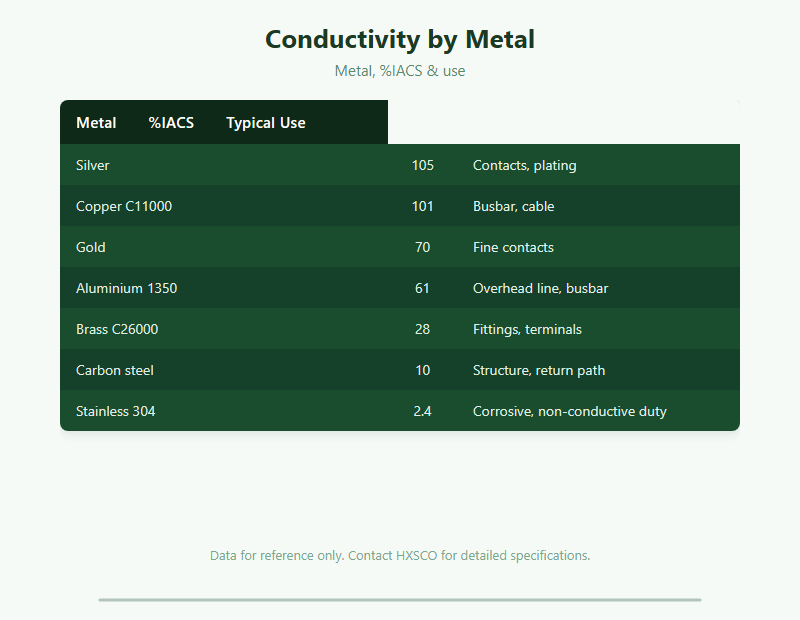
Short answer: Electrical conductivity is quoted as %IACS against pure annealed copper at 100 — silver leads at 105, C11000 copper is 101, aluminium 1350 reaches 61, brass drops to 28, carbon steel is about 10, and stainless 304 only 2.4, which is why conductors are copper or aluminium and never stainless.
At a Glance
How %IACS Works
The International Annealed Copper Standard fixes pure annealed copper at 100 %IACS and rates every other metal against it, which makes conductor selection a single-number comparison. Silver edges ahead at about 105 but only earns its cost as a contact or plated layer. Electrolytic tough-pitch copper C11000 sits at 101 and is the industrial default — the grade behind our Copper Supplier und Copper Busbar Guide programmes, with the oxygen-free comparison in Copper C11000 Vs C12200.
Purity and temper both matter. Alloying wrecks conductivity: adding zinc to make brass drops it to roughly 28 %IACS as covered in Brass Grades Guide und Copper Alloys Guide, and cold work costs a few points that annealing restores. Conductivity also falls as temperature rises, so a busbar rated cold derates when hot.
Copper vs Aluminium in Practice
Aluminium 1350 reaches only 61 %IACS, so a same-current aluminium conductor needs roughly 1.6 times the cross-section of copper — yet at about one-third the density it still ends up lighter and cheaper, which is why overhead transmission line is aluminium. The full trade-off, including creep under bolt pressure and the oxide film that demands proper terminations, is in Copper Vs Aluminum Wire und Busbar Copper Vs Aluminum, and stock comes from our Aluminum Supplier und Aluminum Coil Supplier lines.
Joining the two invites galvanic attack and needs bimetallic lugs or plating — see Galvanic Corrosion Guide und Nickel Plating Vs Chrome Plating.
When Low Conductivity Is the Point
Sometimes resistance is the specification. Carbon steel at roughly 10 %IACS serves as structure and earth return; stainless 304 at 2.4 %IACS is chosen for corrosion resistance and hygiene where conduction is irrelevant, per Stainless Steel 304 Properties. Resistance alloys heat deliberately, and electrical steel is engineered for magnetic rather than electrical performance — high silicon content raises resistivity to cut eddy-current loss, as Silicon Steel Guide und Electrical Steel Supplier explain. Magnetic behaviour is a separate axis entirely, covered in Metal Magnetism Guide.
Thermal conductivity broadly tracks electrical conductivity in pure metals, so copper heatsinks beat aluminium ones for the same reason cables do — while thermal growth still follows Thermal Expansion Of Metals.
Get a Quote
Tell HXSCO your requirements and we will respond with a competitive quote and lead time.
Häufig gestellte Fragen
%IACS rates a metal’s electrical conductivity against pure annealed copper, which is defined as 100. Silver is about 105, aluminium 1350 is 61 and stainless 304 only 2.4.
Silver is the best conductor at about 105 %IACS, followed by copper at 101 and gold at 70. Copper is the industrial choice because silver and gold cost far more.
Copper carries the same current in a smaller section; aluminium needs about 1.6 times the area but is lighter and cheaper. Aluminium dominates overhead lines, copper dominates compact indoor busbar.
Heavy alloying with chromium and nickel scatters electrons, dropping 304 to about 2.4 %IACS. Stainless is chosen for corrosion resistance, not conduction.
Yes. HXSCO supplies C11000 copper busbar, sheet and tube plus 1350 aluminium with conductivity and mill certificates.
Source Electrical-Grade Metal from HXSCO
HXSCO supplies C11000 copper busbar and 1350 aluminium conductor with certified conductivity and mill certificates. Send your current rating and quantity for a quote.