


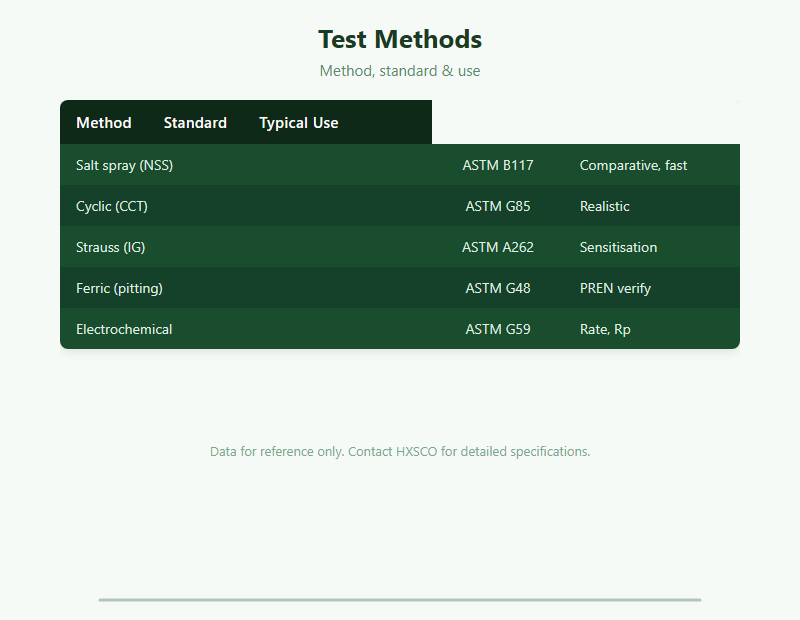
Short answer: Corrosion testing proves a metal or coating will survive its environment — salt spray (B117) for quick comparison, cyclic tests for realism, Strauss and ferric tests for stainless sensitisation and pitting, and electrochemical methods for a corrosion rate.
At a Glance
Salt Spray & Cyclic Tests
Neutral salt spray (ASTM B117) is the fast comparative screen for coatings and plating; cyclic corrosion (ASTM G85) adds humidity and dry cycles for a more realistic result. Both are judged against the failure modes in Galvanic Corrosion Guide und Crevice Corrosion Stainless Steel. They qualify the protection discussed in How To Prevent Metal Rust.
Stainless-Specific Tests
Stainless needs targeted tests: the Strauss test (ASTM A262) reveals sensitisation after wrong heating, the ferric-chloride test (ASTM G48) ranks pitting resistance against PREN, and both confirm the grade choice in Pitting Corrosion Stainless Steel und Intergranular Corrosion Stainless. Surface condition matters — see Stainless Steel Surface Finishes.
Electrochemical & Field
Electrochemical polarisation (ASTM G59) gives a corrosion rate for design, complementing the inspection in Metal Ndt Guide. We certificate protective systems and can quote relevant test methods per Mill Test Certificate Guide so buyers verify before volume supply.
Get a Quote
Tell HXSCO your requirements and we will respond with a competitive quote and lead time.
Häufig gestellte Fragen
Neutral salt spray is a fast comparative test of coating and plating quality — it ranks samples, it does not predict exact service life.
Salt spray is constant; cyclic (CCT) alternates salt, humidity and dry periods for a more realistic, severe-duty result.
The ferric-chloride test (ASTM G48) measures mass loss and ranks pitting resistance, which should match the grade’s PREN.
The Strauss test (ASTM A262) detects intergranular sensitisation from improper heating, relevant after welding or heat treatment.
HXSCO can supply material with specified corrosion-test reports (salt spray, G48, A262) on request; tell us the standard you need.
Source Tested Metal from HXSCO
HXSCO can supply material with salt-spray, G48 or A262 corrosion reports on request. Send your standard, grade and quantity for a quote.