


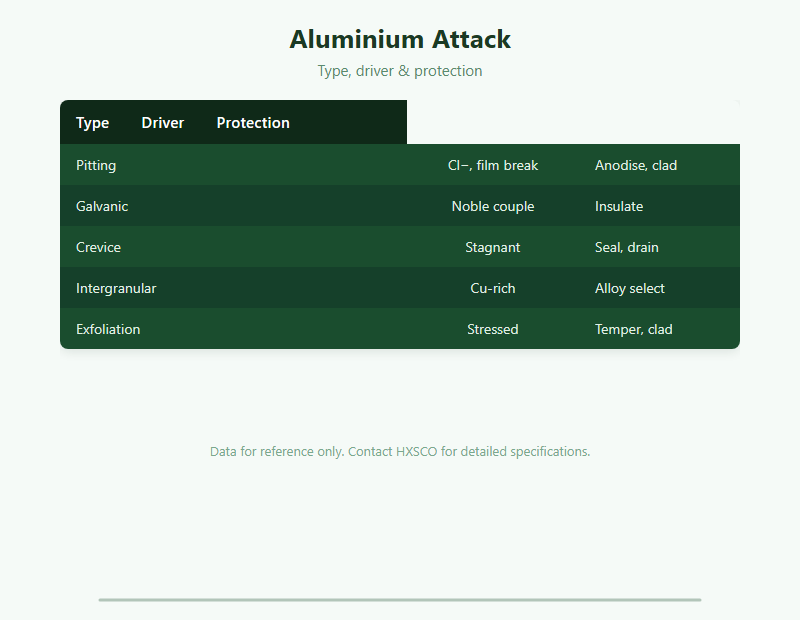
Short answer: Aluminium forms a self-healing oxide film that gives good general corrosion resistance, but it is vulnerable to pitting in chlorides, galvanic attack with noble metals and crevice attack; protection comes from anodising, cladding, insulation and alloy selection.
At a Glance
The Oxide Advantage
A thin Al2O3 film reforms instantly in air, giving aluminium good atmospheric and fresh-water resistance — context in Anodized Aluminum Guide and the Aluminum Alloy Series Guide. Alloy behaviour spans 5052 Vs 6061 Aluminum, 3003 Vs 5052 Aluminum, Aluminum 5052 Properties, 5083 Aluminum Properties und Aluminum 6061 Properties.
Where Aluminium Fails
Chlorides (seawater, de-icing salt) punch through the film as pits; coupling to steel or copper drives Galvanic Corrosion Guide; stagnant crevices localise attack. Marine duty is covered in Seawater Corrosion Guide und Metal Corrosion Inhibitor Guide.
Protecting Aluminium
Anodise or clad (Alclad), insulate dissimilar joints, choose the right temper, and keep it clean; tie to How To Prevent Metal Rust and document per Mill Test Certificate Guide. HXSCO supplies corrosion-selected aluminium with finish options.
Get a Quote
Tell HXSCO your requirements and we will respond with a competitive quote and lead time.
Häufig gestellte Fragen
A self-healing Al2O3 oxide film forms instantly in air and blocks further attack.
Chloride ions break the passive film locally and the spot corrodes faster than the surrounding surface.
Insulate it from noble metals (steel, copper) and avoid conductive bridging.
Aluminium clad with a pure-aluminium layer that sacrifices itself to protect the core from corrosion.
HXSCO supplies 5052, 5083, 6061 and clad aluminium with anodising options for your service.
Source Corrosion-Selected Aluminium from HXSCO
HXSCO supplies 5052, 5083, 6061 and Alclad aluminium with anodising for corrosive service. Send your alloy and quantity for a quote.