


Short answer: ISO 286 defines a tolerance by an IT grade for size and a letter for position — capital letters for holes, lowercase for shafts — so H7/g6 means a nominal-start hole at IT7 with a shaft slightly undersize at IT6, giving a reliable running clearance.
At a Glance
How the ISO System Reads
A fit callout has two halves. The IT grade (IT01 to IT18) sets how wide the tolerance band is, and it scales with size — IT7 on a 25 mm bore is 21 µm, on a 250 mm bore 46 µm, because tight absolute tolerances get exponentially harder as parts grow. The letter sets where that band sits relative to nominal size: H means the hole starts exactly at nominal and goes plus, h means the shaft ends exactly at nominal and goes minus, g sits slightly below, and p, s and u sit progressively above to create interference.
Capital letters are holes, lowercase are shafts, which is why the hole-basis system pairs a standard H hole with whatever shaft delivers the fit. That is deliberate: reaming and boring tools come in standard sizes, so it is cheaper to vary the shaft on a lathe.
Choosing Clearance, Transition or Press
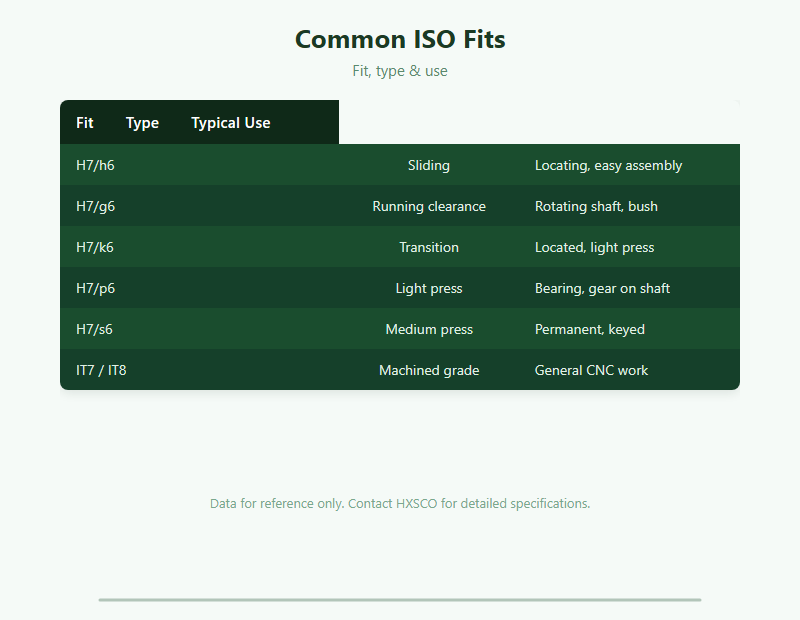
Clearance fits always leave a gap. H7/h6 locates parts that must still slide apart by hand; H7/g6 is the workhorse running fit for a rotating shaft in a bush; H7/f7 and beyond give generous clearance for thermal growth or dirt. Transition fits such as H7/k6 may end up slightly loose or slightly tight and are used where the part must be located precisely but still be removable with a mallet. Interference fits — H7/p6 for bearings, H7/s6 for permanent hubs — hold by elastic deformation alone and need press force or thermal assembly.
Never treat a fit as fixed across temperature. Differential expansion per Thermal Expansion Of Metals can turn a press fit loose or a running fit tight, which matters hard when an aluminium housing carries a steel shaft — see Steel Vs Aluminum for the property contrast. Assembly stress on an interference fit also raises Stress Corrosion Cracking risk in susceptible grades.
Achieving and Verifying Tolerance
Process capability sets what is realistic. General CNC milling and turning hold IT8–IT9 comfortably, fine turning and reaming reach IT7, and grinding, honing or lapping are needed for IT6 and tighter — with cost climbing steeply at each step, so tolerance only the features that carry function. Surface finish must be specified alongside, because a nominally correct bore with a coarse finish will not run: use Surface Roughness Ra Guide. Cutting behaviour varies by alloy per Metal Machinability Guide and our Cnc Machining Supplier programme.
Watch for movement after machining. Residual stress relaxes and parts distort, so critical work is rough-machined, stress relieved per Stress Relieving Vs Annealing, then finished. Heat treatment moves dimensions too, so grind after hardening — see Metal Heat Treatment Guide e Nitriding Vs Carburizing. Plating and anodising add thickness that must be subtracted from the machined size, per Anodizing Vs Electroplating e Metal Surface Treatment Guide. Verification is by gauge, CMM and material certificate per Mill Test Certificate Guide.
Get a Quote
Tell HXSCO your requirements and we will respond with a competitive quote and lead time.
Perguntas frequentes
H7 is a hole whose tolerance starts at nominal size and goes plus at IT7 width; g6 is a shaft slightly below nominal at IT6 width. Together they give a reliable running clearance fit.
An IT grade (IT01 to IT18) defines the width of a tolerance band in ISO 286. The band widens with nominal size, so IT7 is 21 µm at 25 mm but 46 µm at 250 mm.
A clearance fit always leaves a gap so parts move or assemble freely; an interference fit is always tight and holds by elastic deformation, needing press force or heating to assemble.
General CNC milling and turning hold IT8-IT9, fine turning and reaming reach IT7, and grinding, honing or lapping are required for IT6 and tighter.
Yes. HXSCO machines and grinds to your ISO 286 fit callout, with stress relief where needed and CMM inspection reports on request.
Machine to ISO Fits with HXSCO
HXSCO machines and grinds metal parts to your ISO 286 fit and finish callouts with CMM inspection reports. Send your drawing and quantity for a quote.