


Short answer: Heat treatment controls the heating and cooling of metals to alter their physical and mechanical properties without changing shape. Core processes include annealing (softening), normalizing (refining grain), quenching (hardening), tempering (toughening), and case hardening (surface hardening). Each serves distinct purposes across steel, aluminum, copper, and titanium.
At a Glance
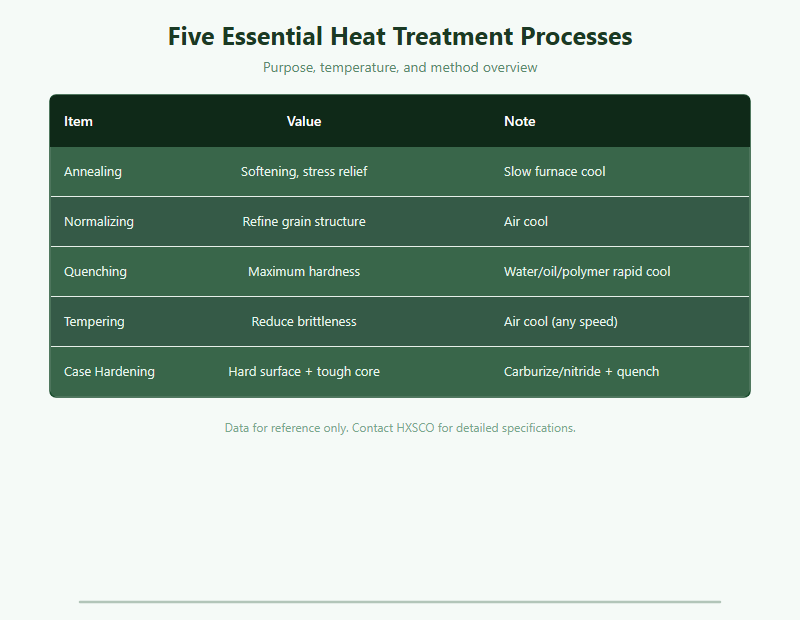
The Five Essential Heat Treatment Processes
| Process | Purpose | Temperature Range | Cooling Method |
|---|---|---|---|
| Recozimento | Softening, stress relief, improve machinability | Above recrystallization | Slow furnace cool |
| Normalizing | Refine grain, homogenize structure | 30–50°C above upper critical | Air cool |
| Quenching (Hardening) | Maximum hardness via martensite formation | Austenitizing temp (varies by steel) | Rapid: water/oil/polymer |
| Tempering | Reduce brittleness, balance hardness/toughness | Below critical (150–650°C) | Air cool (any speed OK) |
| Case Hardening | Hard surface + tough core | Carburizing/nitriding temps | Quench after diffusion |
Annealing: The Softening Process
Annealing heats metal above its recrystallization temperature, holds it, then cools slowly in the furnace. This relieves internal stresses from cold working, refines the grain structure, and maximizes ductility. Three common types:
- Full annealing: Complete softening for severe cold-worked steel. Slowest cool rate.
- Process annealing: Partial softening between cold-working operations. Faster, lower temperature.
- Spheroidize annealing: Produces spherical carbides in high-carbon steel for best machinability. Longest cycle (12–24 hours).
Essential before deep drawing, complex forming, or extensive machining. Applies to carbon and alloy steels; stainless steels require solution annealing.
Quenching & Tempering: The Hardening Duo
Quenching: Heating steel into the austenite phase region (typically 780–900°C depending on carbon content), then rapidly cooling (quenching) in water, oil, or polymer solution. This traps carbon atoms in the crystal lattice, forming hard, brittle martensite. Hardness can reach 60–67 HRC for high-carbon steels.
Tempering: Reheating quenched steel to 150–650°C and holding. Some martensite decomposes into finer carbide particles, trading a small amount of hardness for dramatic improvements in toughness and ductility. The choice of tempering temperature determines the final property balance:
- Low-temp temper (150–250°C): High hardness, still somewhat brittle — cutting tools, bearings.
- Medium-temp temper (350–450°C): Balanced — springs, gears, shafts.
- High-temp temper (550–650°C): Tougher, moderate hardness — structural components, connecting rods.
Case Hardening: Surface Only
When a part needs a wear-resistant surface but must absorb impact (gears, camshafts, axles), case hardening adds carbon or nitrogen only to the outer layer (0.1–2 mm deep):
- Carburizing: Pack carburizing (solid), gas carburizing (CO/CO₂ atmosphere), or liquid/salt bath carbon enrichment at 850–950°C. Quench produces hard (58–63 HRC) case with tough core.
- Nitriding: Diffusing nitrogen into the surface at 500–560°C (no phase change needed). Produces very hard (up to 70 HRC), thin (0.2–0.7 mm) case with minimal distortion. Ideal for finished precision parts.
- Induction hardening: Electromagnetic induction heats only the surface layer locally, followed by quench. Fast, localized, excellent for shafts, gears, and selected wear surfaces.
Heat Treatment for Non-Ferrous Metals
Alumínio: Solution heat treat (470–530°C hold, rapid quench) + aging (natural or artificial at 120–180°C) precipitates strengthening phases (Mg₂Si, Al₂Cu). Critical for 2xxx, 6xxx, 7xxx series. See aluminum alloys.
Copper alloys: Annealing restores ductility after cold working. Precipitation hardening applies to beryllium copper (C17200) and certain bronzes — solution treat + age for high strength + conductivity.
Titanium: Solution aging above/below beta transus controls α/β phase balance. Annealing relieves stress from forming/welding.
Get a Quote
Tell HXSCO your requirements and we will respond with a competitive quote and lead time.
Perguntas frequentes
Annealing uses slow furnace cooling for maximum softening and stress relief. Normalizing uses air cooling — faster, producing a finer grain structure and slightly higher strength. Normalize when you want some softening but not maximum; anneal when you need the softest possible material.
As-quenched martensite is extremely hard but brittle — like glass. Without tempering, a quenched part can crack under impact or sudden load. Tempering trades a modest amount of hardness for dramatically improved toughness, making the part usable in real-world service.
Austenitic stainless (304/316) cannot be hardened by heat treatment — only by cold working. Martensitic stainless (410/420/440C) can be quenched and tempered like carbon steel. Precipitation-hardening stainless (17-4PH, 15-5PH) uses solution + aging treatment.
Carburizing adds carbon at high temperature (850–950°C), producing a deeper (0.5–2 mm), very hard case but with distortion from quenching. Nitriding adds nitrogen at lower temperature (500–560°C), producing a thinner (0.2–0.7 mm), extremely hard case with virtually no distortion — ideal for finished precision parts.
Quenched steel often shows surface oxidation (temper colors: straw → brown → blue → grey depending on temperature). Clean (vacuum or protective atmosphere) heat treatment avoids discoloration. Controlled oxidation can even be used decoratively (blue-polished steel for firearms).
Need Heat-Treated Metal Components?
HXSCO works with certified heat treatment partners to deliver annealed, quenched & tempered, normalized, case-hardened, and aged metal products to your specification. Tell us your required properties and we’ll manage the full supply chain.