



Short answer: Radial forging — rotary forging — reduces and elongates bars, tubes and stepped shafts with several dies striking radially around the part as it rotates, giving a steady, precisely controlled reduction with fine grain and good concentricity. It is the route to long, accurate alloy bars and valve/piston stock that would be hard to roll or open-die forge cleanly.
At a Glance
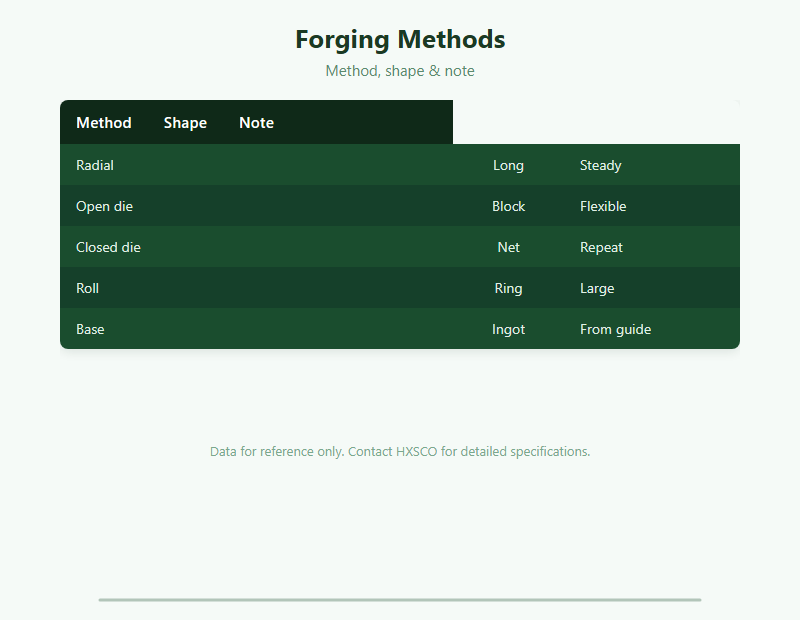
Why Radial Forge
Radial forging fits the Forging Vs Casting chain with Forging Supplier; it adds Metal Strain Hardening Guide and keeps Metal Grain Flow Guide. Compare Metal Cold Forging Guide e Metal Deep Drawing Guide.
Control & QA
Feed and rotation set taper and roundness; inspect by Metal Ndt Guide and document per Mill Test Certificate Guide. Stock from Tool Steel Supplier.
QA & Supply
HXSCO supplies forgeable alloy and tool-steel ingots to spec.
Get a Quote
Tell HXSCO your requirements and we will respond with a competitive quote and lead time.
Perguntas frequentes
Rotary forging with radial dies striking a rotating part.
Radial gives steady, precise long-bar reduction.
Long bars, tubes and stepped shafts with fine grain.
Yes — strain hardening and controlled grain flow raise strength.
HXSCO supplies alloy and tool-steel ingots for radial forging.
Source Forgeable Metal from HXSCO
HXSCO supplies alloy and tool-steel ingots suited to radial forging. Send your grade and quantity for a quote.