


Short answer: Hydroforming shapes tube or sheet by pushing fluid pressure into a sealed blank so the metal expands against a die, producing complex, lightweight, high-strength hollow sections and domed panels in a single operation without welds or seams. Tube hydroforming makes exhaust manifolds, chassis rails and structural nodes; sheet hydroforming makes aerospace panels and pressure vessels — both cut part count and weight versus welding multiple stamped pieces.
At a Glance
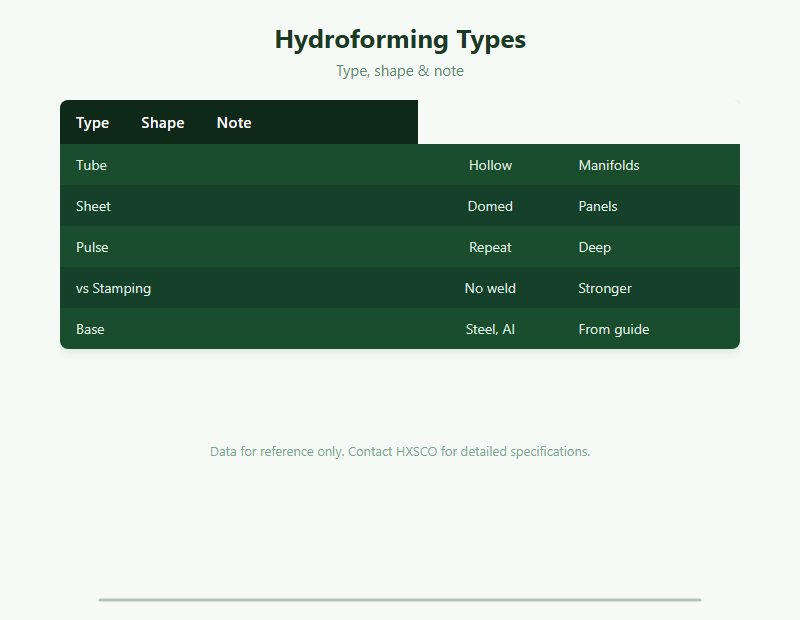
Hydroforming vs Forming
Hydroforming compares with Metal Deep Drawing Guide, Metal Bending Guide e Metal Stamping Vs Machining; pair with Metal Roll Forming Guide e Metal Coining Guide.
Qualidade
Dimensions held per Metal Tolerances Fits Guide, verified by Metal Ndt Guide. Certified by Mill Test Certificate Guide.
Supply & QA
Protect via How To Prevent Metal Rust e Metal Surface Treatment Guide. HXSCO supplies hydroform-ready tube and sheet.
Get a Quote
Tell HXSCO your requirements and we will respond with a competitive quote and lead time.
Perguntas frequentes
Pressurised fluid expands a sealed tube/sheet against a die.
Tube makes hollow sections; sheet makes domed panels.
Fewer parts, no seams, higher stiffness and lower weight.
Carbon steel, stainless and aluminium tube or sheet.
HXSCO supplies tube and sheet suited to hydroforming.
Source Hydroform-Ready Metal from HXSCO
HXSCO supplies steel, stainless and aluminium tube and sheet suited to tube and sheet hydroforming. Send your alloy and gauge for a quote.