


Short answer: Forging shapes metal under compressive force to align grain flow for strength, so buyers choose open die for large simple parts, closed die for repeatable volumes and seamless ring for bearing races, with the component basis in our Forged Components Supplier and property detail in our Comparação de forças.
At a Glance
Forging Processes
Forgings pair with our Forged Components Supplier and our Casting Guide, with the property basis in our Comparação de forças; a quick spec summary is below.
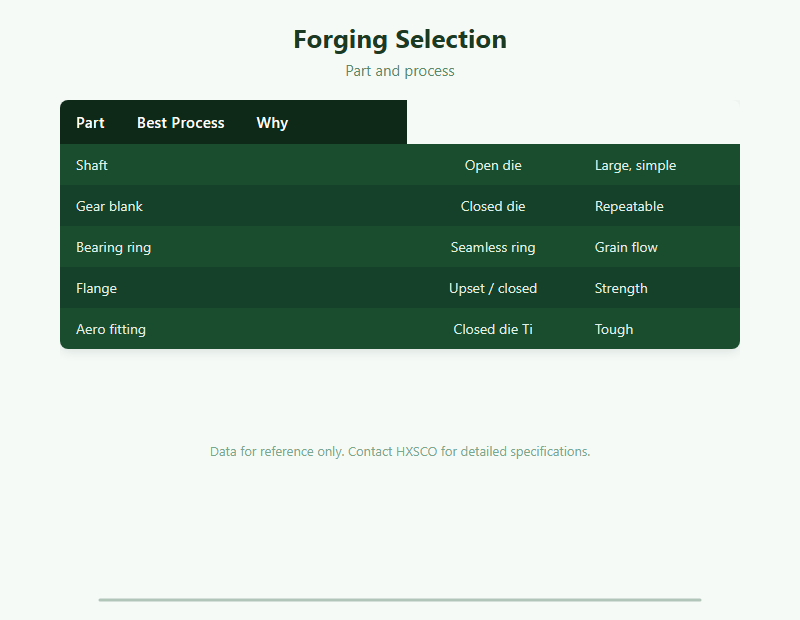
| Part | Process | Benefit |
|---|---|---|
| Shaft | Open die | Large, simple |
| Gear blank | Closed die | Repeatable |
| Ring | Seamless | Grain flow |
Materials and Heat Treatment
We forge Carbon Steel Supplier e Alloy Steel Supplier grades plus Stainless Steel Supplier e Titanium Supplier, with methods in our Heat Treatment Guide.
Tolerances and Inspection
Forgings are machined and NDT-checked, with methods in our Machining Guide and certification in our Mill Test Certificate Guide; fatigue checks are in our Fatigue Guide and NDT in our Quality Inspection Guide.
Procurement Tips
Specify grade, drawing and inspection level, and pack with our Export Packing Guide.
Get a Quote
Tell HXSCO your requirements and we will respond with a competitive quote and lead time.
Perguntas frequentes
Open die for large simple parts; closed die for repeatable volumes.
Carbon, alloy, stainless steel and titanium.
It follows the part shape for toughness and fatigue life.
Yes – normalize, quench and temper as required.
Yes – MTC, UT and dimensional reports.
Supply Forged Parts from HXSCO
HXSCO supplies open die, closed die and seamless-ring forgings in steel, stainless and titanium. Send drawing, grade and quantity for a quote.