


Short answer: Titanium is about 40% lighter than steel at comparable strength and resists corrosion far better, but costs far more per kg. Choose titanium for weight-critical, corrosive or biomedical service; steel for cost-driven structures.
At a Glance
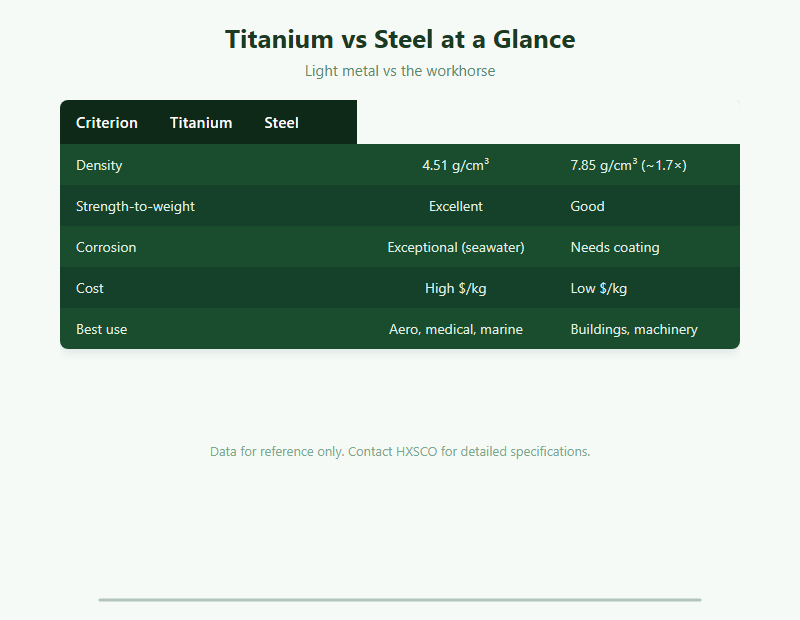
Weight & Strength
Titanium (4.51 g/cm³) is ~1.7× lighter than steel (7.85) with excellent strength-to-weight — why it dominates aerospace. Compare broadly in Metal Strength Comparison and with aluminum in Titanium Vs Aluminum.
Corrosion & Cost
Titanium shrugs off seawater and most chemicals with no coating; steel needs protection (see How To Prevent Metal Rust). Titanium’s price is many times steel per kg, so it is reserved for where the premium pays back. Titanium Grades Guide lists the grades.
When to Choose Each
Use titanium for aero, medical implants, marine and CPI where weight and corrosion rule. Use steel (Carbon Steel Supplier, Stainless Steel Supplier) where budget and stiffness dominate. Metal Corrosion Resistance Guide helps rank environments.
Get a Quote
Tell HXSCO your requirements and we will respond with a competitive quote and lead time.
Perguntas frequentes
At equal weight titanium is stronger; at equal volume steel can be stronger and stiffer, but titanium’s strength-to-weight is what makes it valuable.
Because extraction (Kroll process) and machining are energy-intensive and slow, plus the metal itself is scarce relative to steel.
Barely — it forms a tenacious oxide that resists seawater, chlorine and most acids, which is why it is used in marine and chemical plant.
Direct fusion welding is difficult due to brittleness; use explosive bonding, fasteners or bimetallic transitions and beware galvanic corrosion.
Source Titanium or Steel
HXSCO supplies titanium (Grade 2, 5, 23) and the full steel range in cut lengths. Send your application for a material recommendation and quote.