


Short answer: Stainless steel coil is cold-rolled strip wound into a roll, used for slitting, stamping, and roll-forming. 304 and 316 are the most common grades; 430 and 201 serve cost-sensitive and decorative needs, while duplex coil handles aggressive corrosion. Coils are the starting form for countless fabricated parts.
At a Glance
What Is Stainless Steel Coil?
Stainless steel coil is a long, continuous strip of cold-rolled stainless sheet wound into a roll. It is produced from slab through hot rolling, pickling, and cold rolling to tight thickness and surface tolerances. Typical thicknesses run from 0.3 mm to about 6 mm, with widths from 1000 mm to 2000 mm before slitting.
Because coil is the raw form for stamping, deep drawing, and roll-forming, it is the most economical way to buy stainless when you will fabricate parts in volume rather than use discrete sheets.
Common Coil Grades
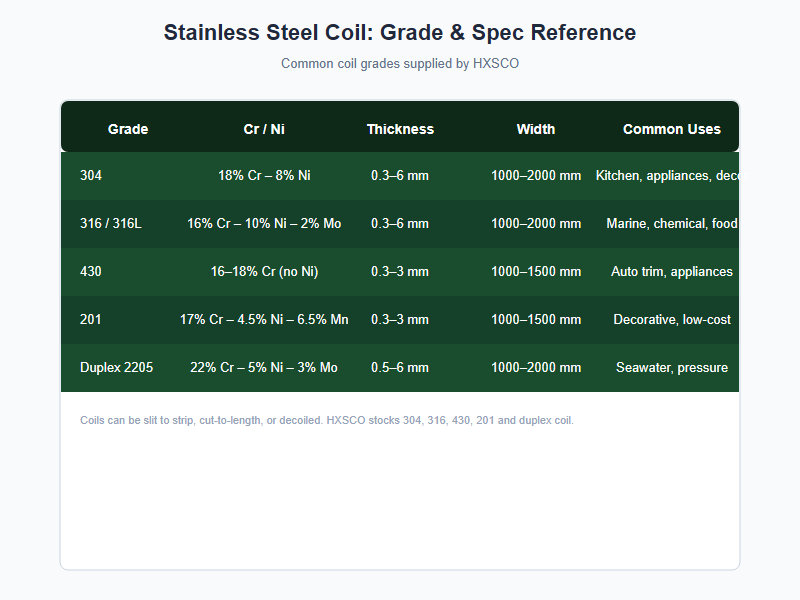
The chart above summarizes the most widely stocked coil grades. Bobina in acciaio inox 304 is the general-purpose default. 316 / 316L coil adds molybdenum for marine, chemical, and food-grade work. 430 coil is the nickel-free ferritic option for appliances and auto trim, and 201 coil is the lowest-cost choice for decorative indoor use.
For seawater, desalination, or pressure equipment, duplex 2205 coil offers roughly double the yield strength of 316 with superior chloride resistance.
Tempers and Hardness
Coil is supplied in several tempers: annealed (soft, for deep drawing), 1/4-hard, 1/2-hard, 3/4-hard, and full-hard. Harder tempers increase strength and spring-back but reduce formability. Specify the temper that matches your stamping or spring requirement.
Surface Finishes
Standard coil finishes include 2B (cold-rolled, dull), BA (bright annealed, reflective), and No.4 (brushed). Colored and patterned coil is available for decorative and architectural cladding. Protective PVC film is commonly applied to prevent handling marks during fabrication.
Buying Stainless Steel Coil from HXSCO
When you request a coil quote, state the grade, temper, thickness, width, finish, coil weight/ID, and quantity. HXSCO can slit coils to strip, cut-to-length, and decoil to sheets. Send your specification and we will quote material, processing, and export packing together.
Domande frequenti
Coil is used for stamping, deep drawing, roll-forming, and slitting into strip. Typical end products include kitchen ware, appliance panels, automotive trim, and architectural cladding.
Common cold-rolled coil ranges from about 0.3 mm to 6 mm. Thicker material is usually supplied as plate rather than coil.
304 is the economical default for general use. Choose 316 coil when the part faces salt, chloride, or acidic environments such as marine or food-processing equipment.
Yes. Coils are routinely slit to narrower widths (strip) and rewound, or cut-to-length into sheets, depending on your fabrication line.
Temper describes how hard or soft the coil is after rolling. Annealed coil is soft and drawable; harder tempers add strength but reduce formability.
Ready to source stainless steel?
Tell us the grade, size, quantity, and destination. HXSCO will reply with a competitive quote, lead time, and mill-test options.
Request a QuoteWhy Buyers Trust HXSCO for Stainless Steel
HXSCO is a stainless steel supplier serving manufacturers, fabricators, and trading companies worldwide. We stock 304, 304L, 316, 316L, 430, 201, and duplex grades in plate, sheet, coil, pipe, tube, bar, wire, and rod forms. Every order can be supplied with mill-test certificates, third-party inspection, and custom cutting/shearing to your drawing. Contact HXSCO for a project-specific quote or material recommendation.