


Short answer: At low temperature many steels lose toughness and can fail by brittle fracture; selecting materials with no ductile-brittle transition (austenitic stainless, aluminium, copper) or a very low transition temperature (nickel steel) keeps components safe in cryogenic and arctic service.
At a Glance
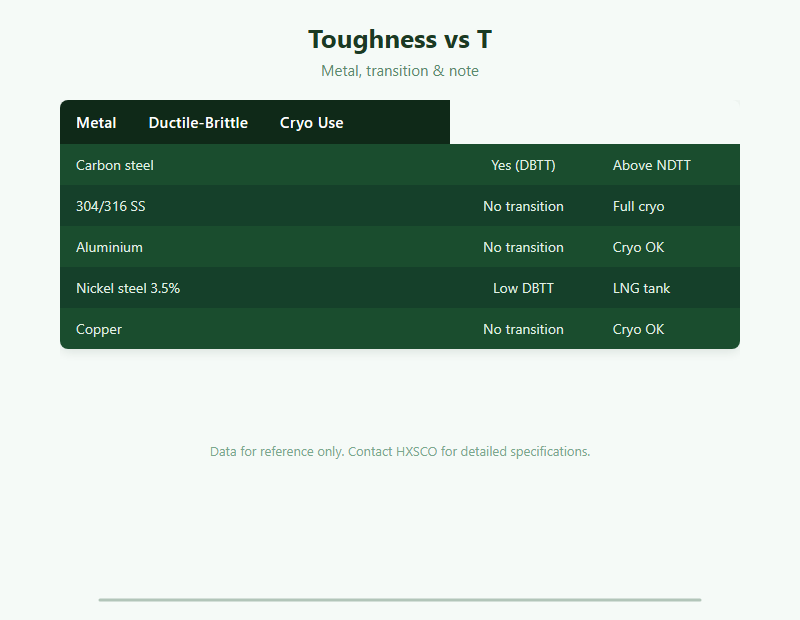
The Ductile-Brittle Transition
Body-centred-cubic metals such as carbon steel lose toughness below their transition temperature and can fail by cleavage — the core of Metal Brittle Fracture Guide y Charpy Impact Test Guide. Austenitic Grados de acero inoxidable explicados, Aluminum Alloy Series Guide y Copper Alloys Guide show no transition and stay tough. Design margins use Yield Strength Vs Tensile Strength y Tensile Test Guide.
Cryogenic Material Choice
For LNG and arctic duty use 304/316 stainless, aluminium 5083/6061 (5083 Aluminum Properties, Aluminum 6061 Properties), copper or 3.5% nickel steel; verify NDTT by impact testing per Mill Test Certificate Guide. Compare with Duplex Stainless Supplier for moderate cryo and Seawater Corrosion Guide contexts.
Design, Welding & QA
Avoid sharp notches (Stress Concentration Guide), control welding heat input via Metal Heat Affected Zone Guide y How To Weld Stainless Steel, and confirm toughness with Metal Hardness Testing Methods y Metal Ndt Guide. Protect storage per How To Prevent Metal Rust.
Get a Quote
Tell HXSCO your requirements and we will respond with a competitive quote and lead time.
Preguntas frecuentes
Many BCC metals cross a ductile-brittle transition and fail by cleavage below a certain temperature (NDTT).
Austenitic stainless, aluminium, copper and 3.5% nickel steel have no (or very low) transition and remain tough cryogenically.
Nil-Ductility Transition Temperature — the temperature below which a metal shows no ductility in a drop-weight test; design above it.
Only above its NDTT; for LNG/arctic use switch to stainless, aluminium, copper or nickel steel.
HXSCO supplies 304/316 stainless, aluminium and nickel steel with low-temperature impact certificates.
Source Cryogenic-Grade Metal from HXSCO
HXSCO supplies stainless, aluminium, copper and 3.5% nickel steel with low-temperature impact certificates for cryogenic and arctic duty. Send your service temp and quantity for a quote.