


Short answer: At low temperature many steels lose toughness and can fail by brittle fracture; selecting materials with no ductile-brittle transition (austenitic stainless, aluminium, copper) or a very low transition temperature (nickel steel) keeps components safe in cryogenic and arctic service.
At a Glance
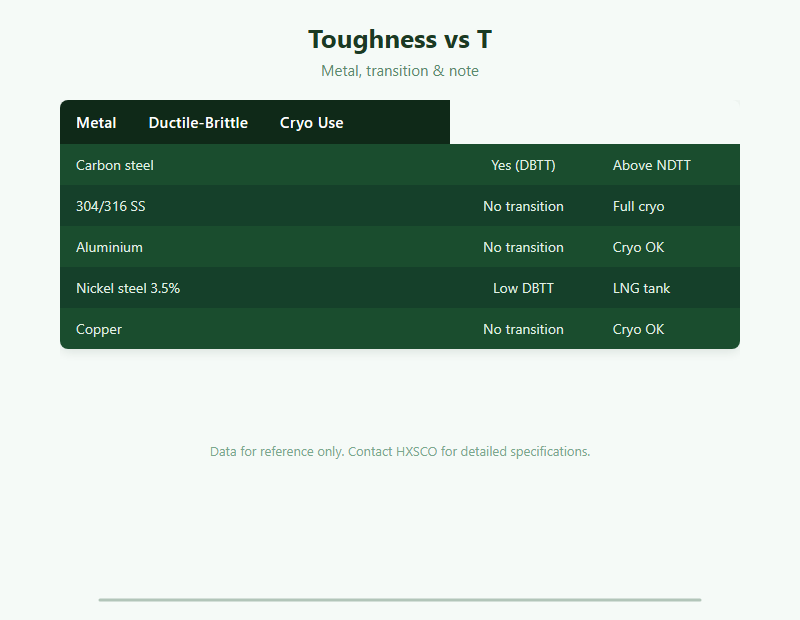
The Ductile-Brittle Transition
Body-centred-cubic metals such as carbon steel lose toughness below their transition temperature and can fail by cleavage — the core of Metal Brittle Fracture Guide et Charpy Impact Test Guide. Austenitic Explication des nuances d'acier inoxydable, Aluminum Alloy Series Guide et Copper Alloys Guide show no transition and stay tough. Design margins use Yield Strength Vs Tensile Strength et Tensile Test Guide.
Cryogenic Material Choice
For LNG and arctic duty use 304/316 stainless, aluminium 5083/6061 (5083 Aluminum Properties, Aluminum 6061 Properties), copper or 3.5% nickel steel; verify NDTT by impact testing per Mill Test Certificate Guide. Compare with Duplex Stainless Supplier for moderate cryo and Seawater Corrosion Guide contexts.
Design, Welding & QA
Avoid sharp notches (Stress Concentration Guide), control welding heat input via Metal Heat Affected Zone Guide et How To Weld Stainless Steel, and confirm toughness with Metal Hardness Testing Methods et Metal Ndt Guide. Protect storage per How To Prevent Metal Rust.
Get a Quote
Tell HXSCO your requirements and we will respond with a competitive quote and lead time.
Questions fréquemment posées
Many BCC metals cross a ductile-brittle transition and fail by cleavage below a certain temperature (NDTT).
Austenitic stainless, aluminium, copper and 3.5% nickel steel have no (or very low) transition and remain tough cryogenically.
Nil-Ductility Transition Temperature — the temperature below which a metal shows no ductility in a drop-weight test; design above it.
Only above its NDTT; for LNG/arctic use switch to stainless, aluminium, copper or nickel steel.
HXSCO supplies 304/316 stainless, aluminium and nickel steel with low-temperature impact certificates.
Source Cryogenic-Grade Metal from HXSCO
HXSCO supplies stainless, aluminium, copper and 3.5% nickel steel with low-temperature impact certificates for cryogenic and arctic duty. Send your service temp and quantity for a quote.